
Members of the Boys were slave labourers in the Boizenburg labour camp, a subcamp of Neuengamme concentration camp.
The Neuengamme concentration camp was operated by Nazi Germany. The camp had 85 subcamps.
The Boys were teenage and child-Holocaust survivors, who were brought to the UK after the war for rest and rehabilitation.
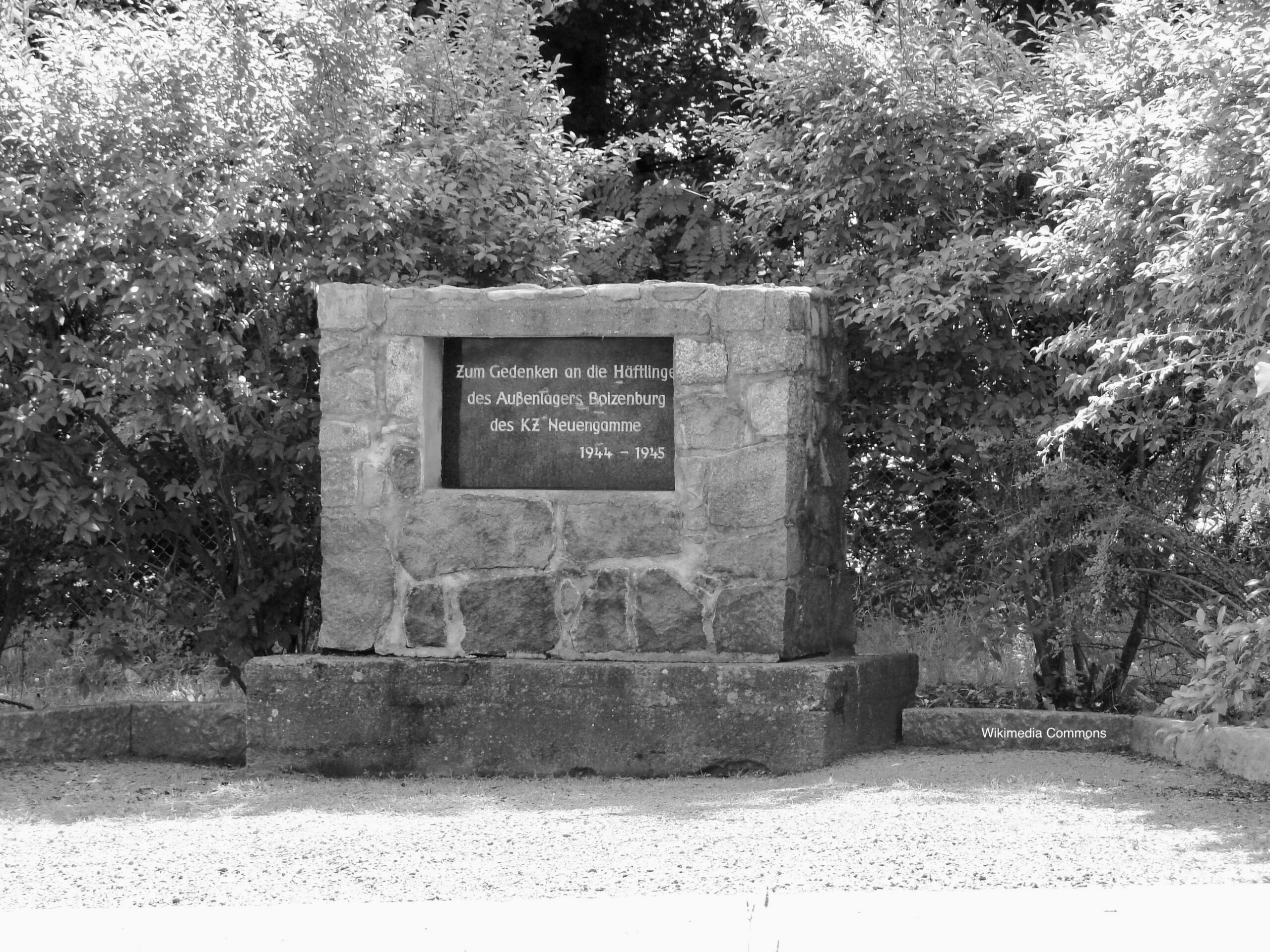
Photograph of the Memorial at the former Boizenburg concentration camp.
In August 1944, the SS set up a Neuengamme satellite camp for women in Boizenburg. As a result, 400 Jewish women from Hungary were transported from Auschwitz II-Birkenau extermination and concentration camp to Boizenburg. The transport took three days with virtually no food or water.
Slave Labour
The women had to work 12-hour shifts, day and night, for the company Thomsen & Co., producing and repairing parts for fighter planes and warships. The malnourished women did not wear appropriate protective clothing and often suffered serious injuries. They were also constantly subjected to harassment and abuse by the mostly female SS guards.
After work at Thomsen & Co. was suspended in March 1945, partly as a result of increasing Allied air raids, the female concentration camp inmates were deployed to repair bomb damage caused by low-level attacks in Boizenburg harbour and in local industrial plants.
Structure
The camp comprised four wooden accommodation barracks, a solid kitchen barrack, a wash barrack, and small wooden outbuildings (infirmary, administration), as well as a watchtower. The exact location of the barracks and outbuildings can be reconstructed from a sketch by eyewitnesses from 1946.
Dissolution
On 8 March 1945, there were 399 female inmates in the camp. The SS evacuated the camp in the early morning hours of 28 April 1945. The SS drove the women towards the Neustadt-Glewe, a subcamp of Ravensbrück concentration camp. However, they were denied entry there for fear of an outbreak of typhus. The women then had to continue walking towards the Wöbbelin concentration camp. A unit of the 82nd US Airborne Division liberated them on 2 May 1945 near Gross Laasch.
Aftermath
After the war, an SS guard at the Boizenburg subcamp was arrested and sentenced to imprisonment in 1948.
The camp complex was used as accommodation for war refugees and displaced persons in the postwar years. The wooden barracks were demolished in 1956. The massive kitchen cellar, which was spared from demolition, subsequently served as storage space for the Elbe shipyard.
Memorialisation
On 3 October 1969, the memorial, designed by the former mayor of Boizenburg and artist Günther Zecher (1929–2013) was inaugurated below the former concentration camp site.
The former kitchen barracks houses the Elbberg Museum Boizenburg.

 About
About History
 Education
 Quilts
 FIlms
FIlms Photos
 News Media & Events
 Publications
 Donate