Members of the Boys were imprisoned in the Końskie Ghetto.
The Końskie Ghetto was one of a network of ghettos set up by Nazi Germany in which Jews were forced to live in occupied Poland. As with other ghettos in Czechoslovakia, Latvia, Lithuania and Poland, the Końskie ghetto was established to contain the region’s Jews and isolate them from the rest of the population until the Nazi leadership could decide on an answer to the so-called “Jewish Question.”
The Boys and their families were forced to move from their homes and were held in ghettos in Nazi controlled Czechoslovakia, Latvia, Lithuania and Poland, where they spent years living in dire conditions. The ghettos were not designed for the vast numbers of people forced to find space to live within them. As a result, multiple families shared cramped and insanitary accommodation.
The Boys were teenage and child-Holocaust survivors, who were brought to the UK after the war for rest and rehabilitation.
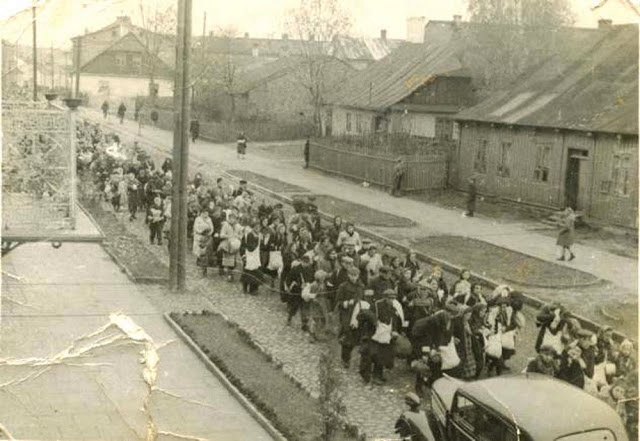
Konskie Jews being deported to the Treblinka extermination camp
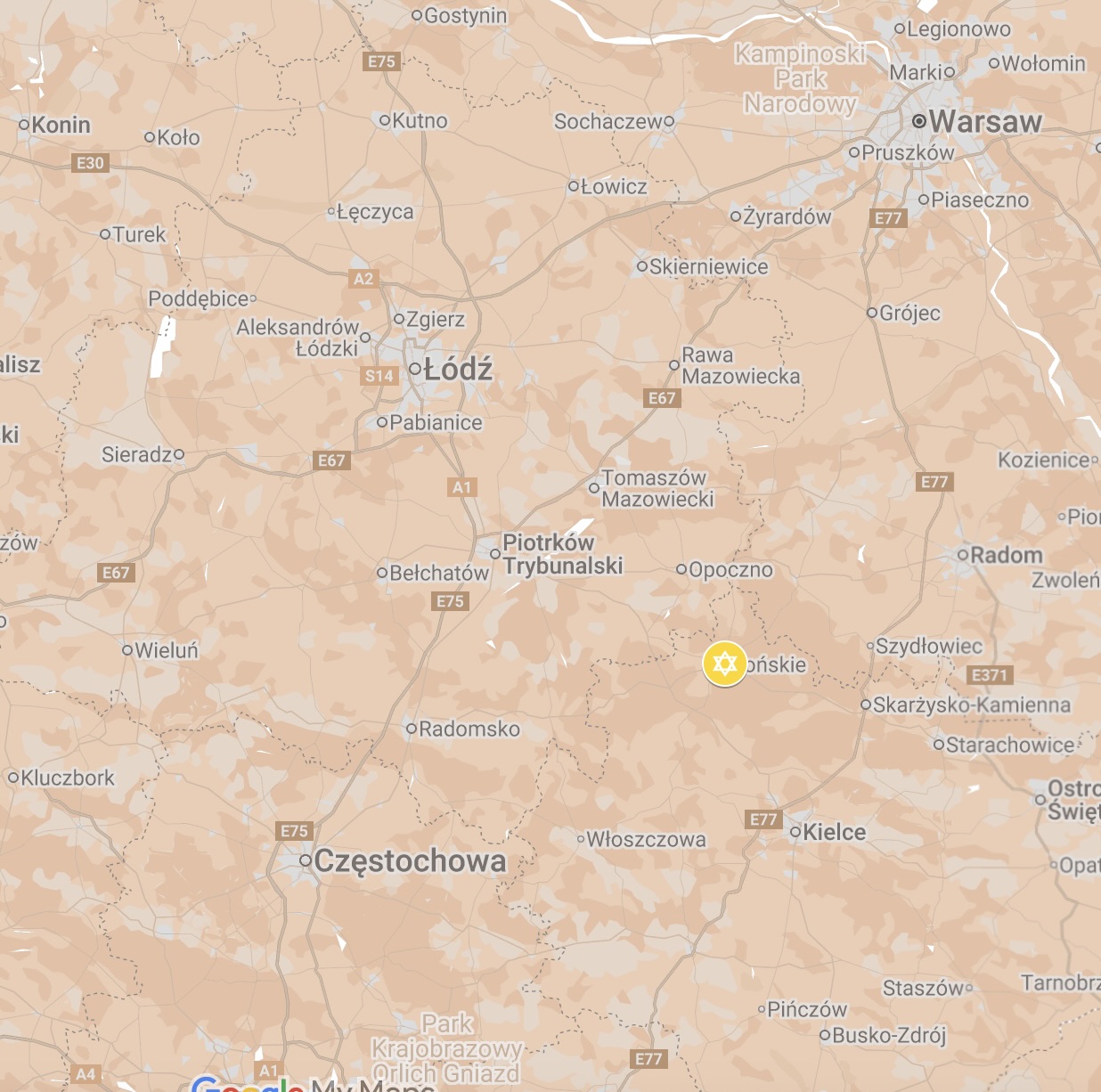
Końskie is a small town 130km south of Warsaw. To find out more about the Świętokrzyskie Voivodeship and the Boys who grew up there click here.
Overview
The ghetto in Końskie was set up in in 1940. In February and March 1941, the first transports of Jews from the Polish territories incorporated into the Reich arrived in the town principally from Łódż, Płock and the surrounding towns. The ghetto was closed off from the rest of Końskie in the spring of 1941. The Nazis intention was to isolate the Jewish population from the rest of the city.
Layout
The ghetto included the following streets: Kilińskiego, Piłsudskiego, Pocztowa, Bóżniczna, Jatkowa, Joselewicza, Nowy Świat, Przechodnia, Kazanowska, Krakowska, part of the Market Square and 3 Maja. The ghetto consisted of two parts connected by a narrow tunnel under ul. Maja.
The ghetto was surrounded by a wooden fence or barbed wire. The windows of the buildings facing outside the ghetto were boarded up. The ghetto gates, as well as the passage between its two parts, were guarded by the Jewish police. Communication between the parts of the ghetto was only possible at designated times.
Daily Life
Non-Jewish residents outside the ghetto traded goods for work by Jewish tailors. Initially, sick residents in the ghetto were treated in the town’s public hospital. The Judenrat (Jewish council) paid for those who were unable to cover the costs. In June 1942, a Jewish hospital was established in the ghetto.
When news of the liquidation of other ghettos reached the Jews of Końskie, they tried to save themselves by finding employment. The best protection seemed to be to work in agriculture, outside the city. These jobs were reserved for men. As a result, the Gestapo was bribed to grant unpaid work to about 30 girls from wealthier families. They were employed at the Hitlerjugend school, to which they were escorted by the Jewish police. In September 1942, their employment was suddenly terminated.
Deportations
On 3 November 1942, the ghetto inhabitants, surrounded by cordons of German and Lithuanian troops, were gathered in the market square.
Between 3-7 November 1942, 6,000 Jewish men, women, and children were loaded into freight wagons and taken to the Treblinka extermination camp 271km away.
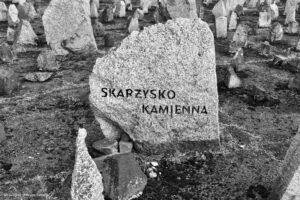
A memorial at the former extermination camp of Treblinka in modern-day Poland.
On the day of the deportation from Konskie, a German officer from Skarzysko-Kamienna slave labour camp came to the ghetto and made a speech. Chaskiel Rosenblum, then 14 years old, was one of those who heard it.
“He said he needed one hundred strong Jews to work at Skarżysko and promised they would have plenty of food. My father took me by the hand and we jumped into the truck. The German said to me: ‘No, we don’t need children’. My father told him: ‘Then I’m not going either’. The German said: ‘Alright, get on the truck’. This was my first step to survival. And this was the last time I saw my mother and three sisters – waving goodbye while the truck started moving. They were sent to Treblinka and died there. None of them survived.”
Chaskiel Rosenblum quoted in Martin Gilbert, The Boys: The Story of 732 Young Concentration Camp Survivors (Weidenfeld &Nicholson, 1996).
Rosenblum’s father died in Skarzysko-Kamienna.
Jewish Resistance
There is no reported Jewish resistance movement in the Końskie Ghetto.
Aftermath
After the transports left, several hundred Jews in the city, who had evaded the deportations, were gathered in a temporary labour camp, where they sorted property that the ghetto inhabitants had left behind. On the night of 6-7 January 1943, all the Jews who were still in the city, about 300 in total, were deported to the ghetto in Szydłowiec, from where they were sent to the Treblinka on 13 January 1943. To find out more about visiting Świętokrzyskie Voivodeship click here.
 About
About History
 Education
 Quilts
 FIlms
FIlms Photos
 News Media & Events
 Publications
 Donate