The Boys were given visas that allowed them to stay in the UK for two years. No sooner had the members of the fourth group arrived in London the Central British Fund began to make arrangements for the Boys to find new homes overseas.
The Boys were teenage and child-Holocaust survivors, who were brought to the UK after the war for rest and rehabilitation.
Members of the Boys were held in Nazi labour and concentration camps and used as slave labourer. They had also survived World War II in hiding or as lone children.
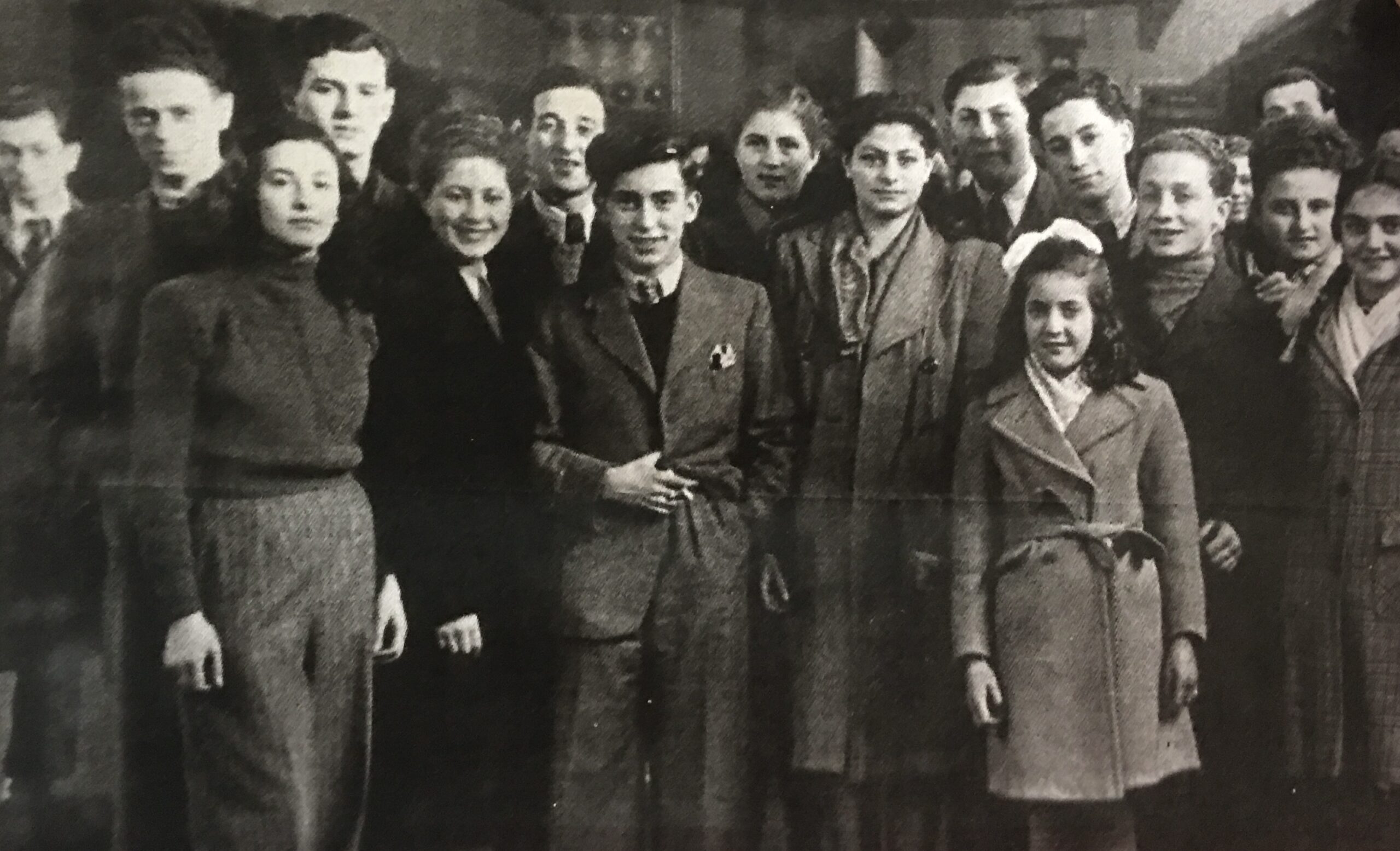
The Boys go to Canada on the War Orphans Programme in 1947.
As the hostels closed, the Boys began to make their own way in the world. The Boys were keen to start new lives but it was a period of difficult adjustment and loneliness for many.
Some decided to make Britain their home while others found relatives abroad, especially in Canada and the United States.
Friends who had survived the camps together now found themselves separated and alone.
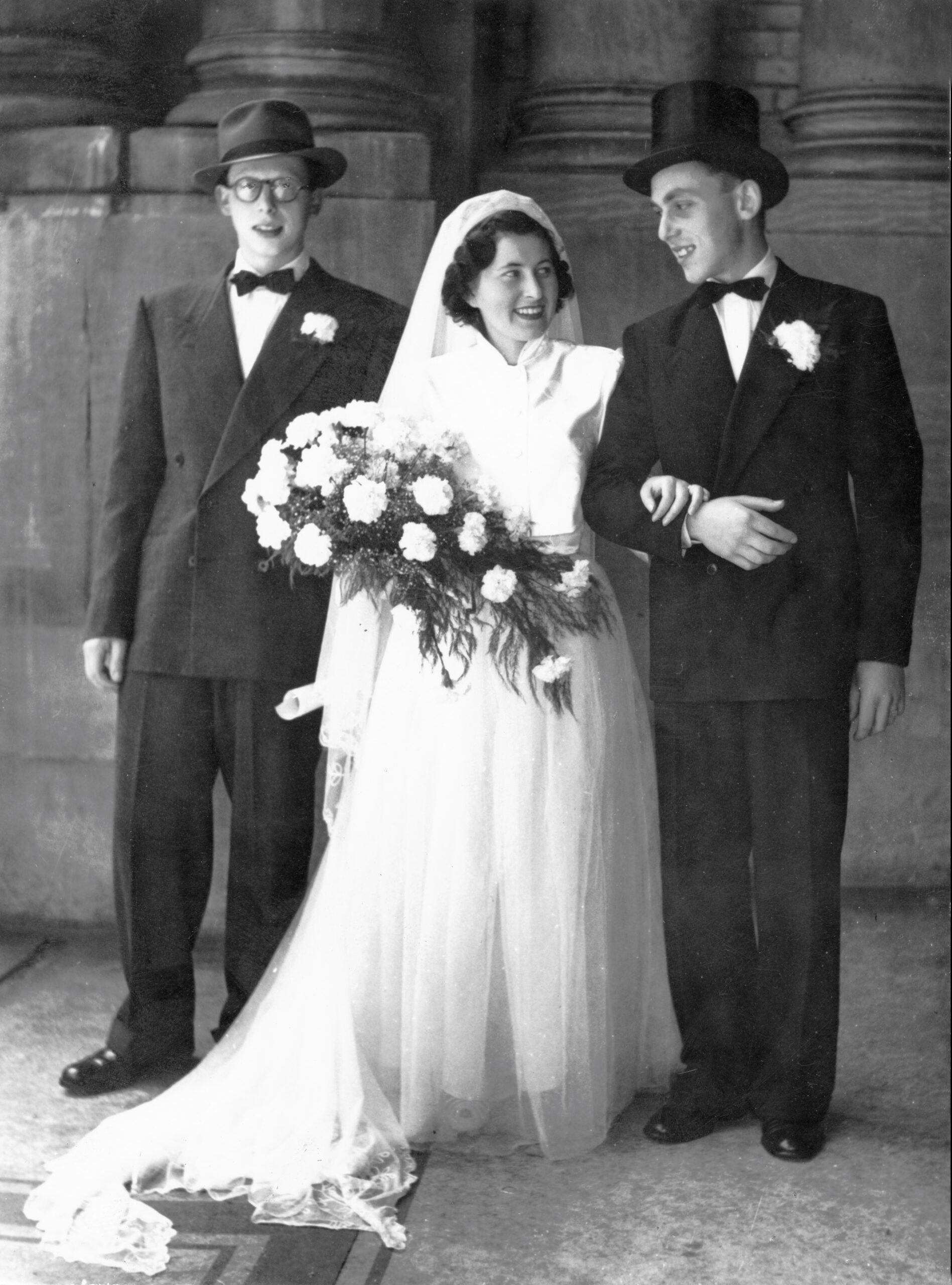
The Central British Fund interviewed the Boys about their hopes for the future. However, the limited funding that they had made it impossible to grant all their wishes.
Education & Training
The older Boys were encouraged to go to the ORT School where they received vocational training. Younger children attended school. Education for many of them was a struggle; they had only just begun to understand English when they found themselves struggling to understand Shakespeare.
For many of the Boys, catching up on their lost years of schooling was an act of revenge against the Nazis and number of them attended universities and polytechnics. Of those who there were many who excelled in their fields and became university professors.
Besides education, independence was an important factor that drove the Boys choices. Many of the girls found this a major challenge. Sala Hochspeigel remembers that it was one of the reasons that she chose to train as a nurse, as she was given her own room in the nursing home.
“Where we made our breakthrough was in the classroom. Our young friends were not just tough, they were also highly intelligent. And they wanted to learn. It was as if they were trying to make up for lost time. Even now, all these years later, I confess to an enormous feeling of pride when I think of the orphans who, against all the odds, escaped the gas chambers and the firing squads to become no ordinary citizens, but leaders in their chosen occupations.
Shared experience – the achievement of having pulled through – created a powerful bond of comradeship. Unlike the pre-war refugees who wanted to put away the past, the children of the concentration camps had a need for a continuing association. No doubt many were seeking reassurance. Accustomed to a small closed, society, the world outside could be frightening in its complexity. But also, I fancy, there was an awareness that as a community, they stood for something. Not one of them today would express such grand sentiments, but they knew then, as now, that they had fought a massive evil and won.”
Elaine Blond, Marks of Distinction: The Memoirs of Elaine Blond (Vallentine Mitchell, 1988).
Meeting the British
The Boys had to face outsiders’ reactions to their experiences. Most people they met had no comprehension of what had happened to them and often disbelieved what they said. They were often greeted with hostility, even among the British Jewish community.
Building New Families
Most of the Boys married and had children and there were notable romances among the Boys themselves.
This was a moment when they missed their parents and siblings acutely, as they had no one to turn to for advice and there was little forthcoming from the Central British Fund.
Military Service
Some members of the Boys joined the British Army.
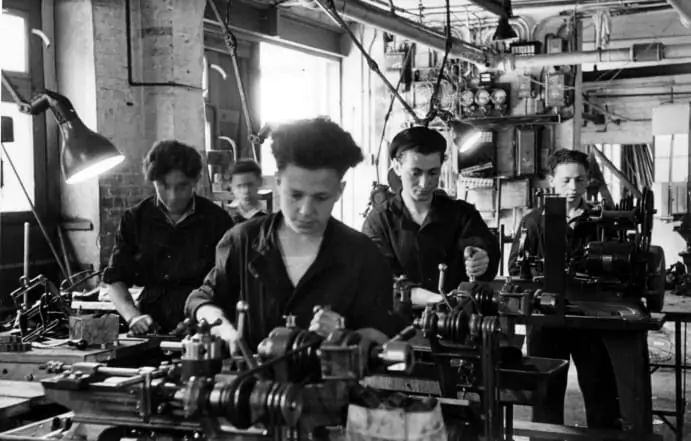
Immediately after liberation the majority of the members of the Boys wanted to make new lives in Palestine. Many of them would eventually settle in Israel. For some of them, the Bachad-run Kibbutz Lavi would become a new home.
Zionism
Many had signed up to come to Britain in the hope it would be the fastest route to Palestine, which was at this point controlled by Britain under the League of Nations Mandate system. They had been part of Zionist families who had hoped to settle in Palestine before the war as they saw no future for themselves in Europe.
Between 1945 and 1948, British government policy put the authorities on a collision course with British Zionists. In the March 1939 White Paper, the British government had imposed strict limits on Jewish immigration into the Palestine Mandate that they controlled.
The Labour Party had promised in the 1945 election campaign to repeal the White Paper. When they took office in the summer of 1945, they did not keep their promise. The 100,000 British troops garrisoned in Palestine soon found themselves in the frontline fighting a Jewish insurgency.
Coupled with this was a post-war food and fuel shortage, in short supply in the UK. The Jewish community was blamed for the shortages and levels of anti-Semitism in Britain the early summer of 1946 reached a new high. Tabloid headlines reported attacks on British soldiers in Palestine, which inflamed public opinion and would eventually lead to widespread riots in British cities.
On June 29, 1946, the crisis in Palestine deepened when the government ordered the arrest of Jewish leaders as part of Operation Agatha. The following Sunday, British Jews took to the streets of London in their first large-scale public protest. Many of the Boys, even those living outside the capital, took part and their black-and-white photograph collections usually include snaps of the protest that culminated in Trafalgar Square.
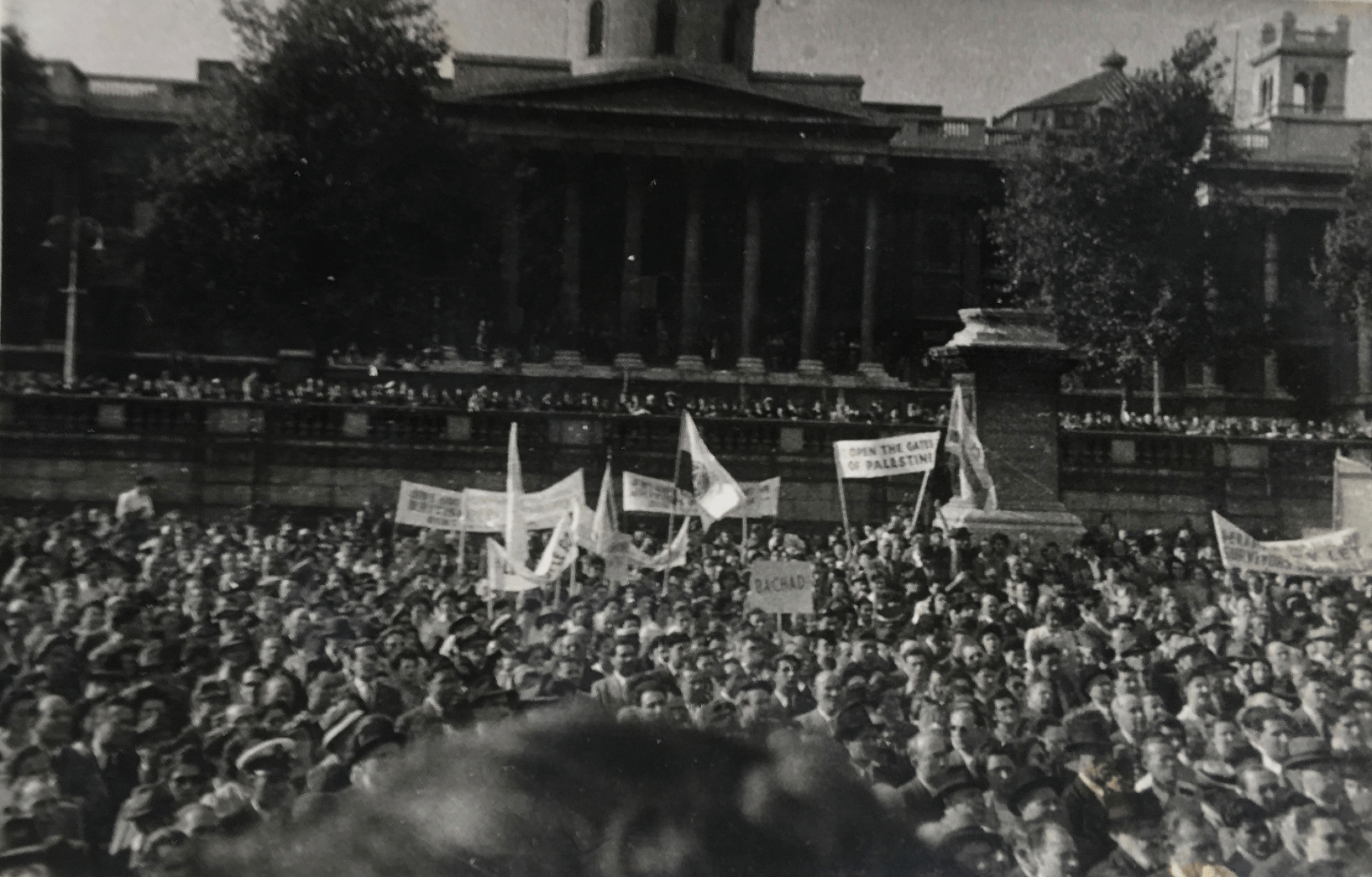
A protest in Trafalgar Square against British policy in the Palestine Mandate in 1946.
1948
Many of the Boys volunteered to fight as Machal volunteers in the 1948 Arab–Israeli War. Some 4,000 volunteers, mostly Jews but also non-Jews, arrived from all over the world to fight alongside Israeli forces. Machal is an acronym of מתנדבי חוץ לארץ (Mitnadvei Hutz LaAretz, “volunteers from abroad”). There were 600 volunteers from Britain but the Boys who volunteered to fight are not included in this figure, as at the time they were stateless.
The Machal volunteers were a small percentage of the Israeli fighting forces, but were assigned to virtually every unit in the Israeli army, navy and air force. Mahal was disbanded after the war and most of the volunteers went home, although some remained in the country as permanent residents.
It was illegal to volunteer to fight in the newly founded state of Israel so recruitment was carried out by the Jewish underground, the Haganah. They had a recruitment office behind a bookshop on Charing Cross Road run by a ‘Mr Gross’. They also visited the ORT training ship and recruited members of the Boys who had been trained as sailors as they were needed for the nascent Israeli navy.
Leaving the UK
The Boys who decided that they wanted to volunteer to fight had to obtain permits to take a holiday in France or Switzerland. They then went to Dover and crossed the Channel to Calais. There they were met by French members of the Jewish underground and given tickets to travel by train to Paris.
Chaim Liss in the UK.
“I left England in August 1948, after I had volunteered to join the Israeli army. Earlier I was furnished with a travel permit, a titre de voyage, with a visa through France. I crossed the Channel from Dover to Calais. I remember the customs official in Dover asking whether the clothing I was taking wasn’t a bit light for Switzerland. It seems that although we attempted to disguise our true destination, the British knew where we were heading.”
“I was not alone on the trip. Travelling with me were a few of the ‘boys’ such as Menachem Silberstein, Sam Freiman, Jimmy (Zelig) Rosenblatt, Zvi Brand and David Turek. From Calais we took the train for Paris where we reported to an office in the Boulevard Haussmann. We spent only a few hours in Paris and went by train to Marseille where we arrived some twelve hours later. In Marseille we stayed in Camp St Jerome, which for some reason served as a transit camp for volunteers for the Israeli forces. For some reason we had to stay there for nearly two months, when we were flown to Haifa. During our stay we had some sort of military service which lay ahead in Israel.”
Chaim Liss quoted in Martin Gilbert, The Boys: The Story of 732 Young Concentration Camp Survivors (Wiedenfeld and Nicholson, 1996).
In Paris they were told to report to an office on Boulevard Haussmann, which was the European headquarters of the Jewish underground. They were treated to dinner in a fancy restaurant before boarding the night train for Marseilles. Dotted around the Mediterranean port city were camps where the Jewish underground gave them basic weapons training before they sailed or flew to Haifa.
At the Tel Litvinsky camp, a former British military base, they joined the newly established 7th Brigade, which was made up of English-speaking volunteers. The unit had been set up after a senior American military advisor, who was the commander of the Jerusalem front, was accidentally shot dead by a Hebrew speaking soldier who had not understood when he gave the necessary password in English.
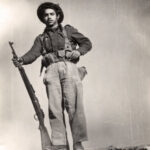
Krulik Wilder in the Israeli army, 1948.
“When a cease-fire was arranged I decided to return to England as my travel document was expiring and I wanted to become a British subject.
Looking back I am very proud to have participated in the War of Israeli Independence and to have belonged to the select group of what is known as Mahal.
When I was shunted around for four weeks from Buchenwald to Theresienstadt, and was literally gasping for life, the last thought that would have been in my mind was that I would one day play my part in fighting for a Jewish State, an aspiration for which our ancestors had been striving for two thousand years.”
Krulik Wilder, written testament 1995.
After a brief stint in the trenches near Lydda airport, the volunteers were assigned to fight. Some went to the Negev, others were sent north to the Upper Galilee. The United Nations partition plan had designated the Upper Galilee to be part of an Arab state—a proposal rejected by the Arab leadership. After the Arab Liberation Army (ALA), a volunteer force of Palestinians and other Arab nationals formed by the Arab League, broke the third ceasefire of the war, Israel’s first Prime Minister, David Ben-Gurion, ordered a military operation to drive them out of the Upper Galilee. He also sought to expel the local Arab Palestinian population. Fierce battles followed, in which the Boys took part.
David Hirshfeld in the hostel in Loughton.
David Hirshfeld volunteered without telling his brother Moniek, who was the only member of his family who had survived the Holocaust.“It was an illegal activity and I didn’t want to influence him to take a similar risk,” he wrote later.“It might be difficult to understand why people like us who were barely saved from extermination would volunteer,” he admitted, but felt it was “essential for the Jewish people to have a place of their own, where they can protect themselves and have their own armed forces.”
Among those who looked after the Boys in the UK was the religious Zionist movement Bachad. Members of Bachad, today Bnei Akiva, were involved in the Jewish underground in the UK.
Edi Maagan and her late husband, Shalom Markowitz, one of Bahad’s leaders, ran a hostel for young survivors in London’s East End in Cazenove Rd. Her basement was a hub of activity for the London branch of the Haganah—the underground force that would later become the Israel Defense Forces. Those who had joined up spent their last night in the United Kingdom in Edi’s home and were given their final briefing.
One of the Bachad volunteers was 22-year-old Esther Calingold, who was killed fighting in the Old City of Jerusalem in in the summer of 1948.
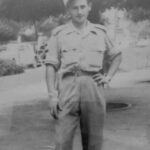
Sam Freiman in Israel as a Machal volunteer 1948.
Sam Freiman was 22 years old in 1948. He was the sole survivor of not only his family but the entire Jewish community of Jeziorna in Poland.“I felt I had an obligation to fight for a Jewish state as my father had been a staunch Zionist,” he recalled.“If he could have seen me fighting, he would have been so happy and gone straight to heaven!” He wanted to settle in Israel but found it impossible to get a job, so had to return to the UK. The Central British Fund had to clear his papers so he could enter the country. Before his death in December 2019, he proudly showed visitors to his apartment a grainy picture of him in his first IDF uniform.
Many of the Boys who fought in the battles of 1948 remained in Israel but many returned back to the UK. Some because they felt their home and their future lay elsewhere or others because life in Israel was simply too hard and they were unable to find work.
The IDF
Those who stayed in Israel fought in subsequent wars in the Israeli Defence Forces (IDF), as did those members of the Boys who arrived in Israel after 1949.
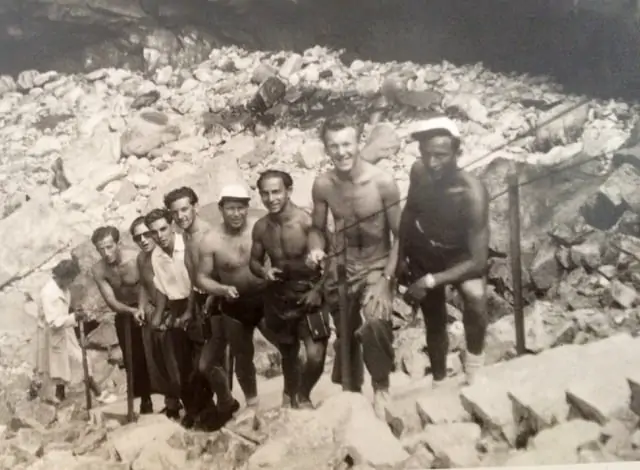
Many members of the Boys settled in Canada. Most of those who went to Canada between 1947 and 1949 were accepted on the Canadian War Orphans Project.
Background
Between 1947 and 1949, 1,123 Jewish orphans who had survived the Holocaust were allowed to settle in Canada. In 1947, the Canadian Jewish Congress (CJC) persuaded the government to allow about 1,000 young Jewish refugees to immigrate to Canada.
Until now the Canadian government had been reluctant to let in Jewish refugees. In 1942 the CJC had lobbied the federal government in 1942 to bring over 500 Jewish children from Vichy France, whose parents had been deported to Auschwitz in the summer of 1942. Canada’s immigration department, under the purview of the openly anti-Semitic Frederick Blair and Prime Minister William Lyon Mackenzie King, reluctantly agreed to permit them into the country but by the time the government accepted the paperwork, the Nazi Germany had occupied Vichy, France.
After the war, national attitudes towards immigration started to change. Canadians found themselves with a suddenly booming economy, resulting in a labour shortage that convinced the government to accept the limited immigration of European refugees, despite a majority of citizens still staunchly opposed to their migration.
Strict guidelines were applied to the project that mirrored those imposed by the British government:
The children had to be under 18 years of age.
The CJC had to accept the full legal and financial responsibility.
The children would be cared for by Jewish foster families or become self-supporting.
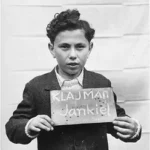
Jankiel Klajman in Kloster Indersdorf, Germany in 1945.
“Only ten days after applying, I was on my way. All I had to do was pass a medical exam and brief interview with Canadian government officials.
Like the other orphans going across the Atlantic on the Aquitania – I was embarking on a great adventure on a massive ocean liner. As it departed from Southampton on January 4, 1948, all I had was forty dollars in Canadian currency, a bag full of clothes, an accordion, a violin the Northampton headmaster had given me as a going-away gift, a few school books and some photos and other memorabilia from two-and-a-half wonderful years in England.
I found myself sitting at the piano playing tunes, singing songs and drinking beer only moments after hitting the high seas. But the fun lasted all of about one hour. It took five days to get to Halifax and I was sick on each of them. With the exception of that first hour, I spent the whole trip in bed.
Five days later, a Friday afternoon, we arrived in Halifax. We were greeted by members of the city’s Jewish community and a reporter from a local newspaper, who wrote about our arrival. We spent the weekend in Halifax before heading on to Montreal and Toronto.”
Once the approval to bring in the 1,000 Jewish orphans was granted in 1947, the CJC had three months to come up with a plan. It convened committees in Winnipeg, Montreal and Toronto to raise the money for the programme and recruit the foster families.
In the spring of 1947, the CJC sent three scouts to Europe to find the orphans. The CJC faced the same challenges as the Central British Fund had encountered when trying to bring orphaned Jewish children to the UK. Among them was the insistence of Zionists in the DP camps that the children should settle in the Palestine Mandate and the reluctance of governments to release the children to their care.
The main entry point for over one million immigrants to Canada between 1928 and 1971 was Pier 21 in the port of Halifax in Nova Scotia. The members of the Boys who were accepted on the War Orphans Project all arrived at Pier 21. Today, Pier 21 is a Canadian Historic Site and museum.
The members of the Boys who went to Canada were joined by other orphans who had similar experiences and had been in the DP camps in Germany. Greta Fisher, who had fled Czechoslovakia for London in 1939 brought the last group of orphans from the Kloster Indersdorf children home in Bavaria. Fifty members of the Boys had spent time in the home before they came to Britain in October 1945.
Fisher had worked with Anna Freud in the Hampstead War Nursery during World War II and had joined the UNRRA Team 182, at Kloster Indersdorf in the summer of 1945. She settled in Canada were she continued to work as a social worker.
Not all the members of the Boys who joined the War Orphans Project settled in Canada. Many later lived in the USA.
Eventually, some 140,000 survivors settled in the United States. Many members of the Boys were among them.
Life in the USA
In 1946, the United Service for New Americans (USNA) was created to oversee the national resettlement of survivors, and the New York Association for New Americans (NYANA) was founded in 1949 to assist the many newcomers who settled in New York. Individuals also sponsored surviving relatives.
Survivors recalled that American Jews had little understanding of or interest in what the newcomers had recently endured and discouraged mention of wartime experiences.
Military Service
Those male members of the Boys who decided to settle in the United States had to do their military service in order to qualify for citizenship.
Many of them were on active service during the Korean War and a least one member of the Boys was in Vietnam.
Some of those conscripted in the US Army were deployed in Germany and worked for military intelligence.
“It was a great promotion, from being a despised prisoner without right or value, to being an American soldier, at that time, an elite. I had what was considered a prestigious job. I was in military intelligence because of my language skills and having scored high on my aptitude tests. With the exception of the first months spent in Nuremberg in processing, I spent ten months in Bavaria as a member of an intelligence team … I was the envy of my American military comrades, and was treated respectfully and enviously by the German population. My social life bloomed and I enjoyed the appetites of youth to the full. I felt no need for vengeance, nor did I have any bad feelings toward the regular civilian population.”
Jack Rubinfeld written testament 1996.
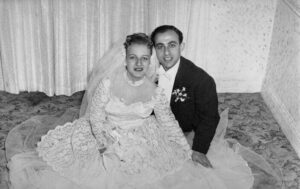
Henry Brown’s wedding.
Some of the Boys settled in South America, where they also had relatives, while at least three of the Boys returned home.
The Holocaust scattered survivors across the globe.
Later in life, especially after retirement, when the Boys had built new families and careers – had finally survived – they dedicated themselves to Holocaust education not only in countries where they had settled but in their birthplaces. The ’45 Aid Society continues their work.
Testaments
The Boys made written testaments, which are included on thos website. Click here to read them. They also made recorded and video testaments. On each of the Boy’s profiles there is a link to these testaments.
The ’45 Aid Society is active in Holocaust education.
To find out more about the resources we offer click here.
Our Education Team can advise on how to deliver the story of the Boys by booking a suitable speaker and can help teachers devise lesson plans.
Critical Thinking Questions
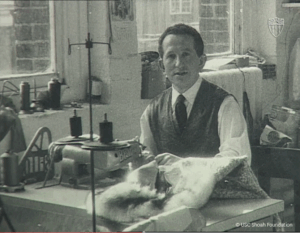
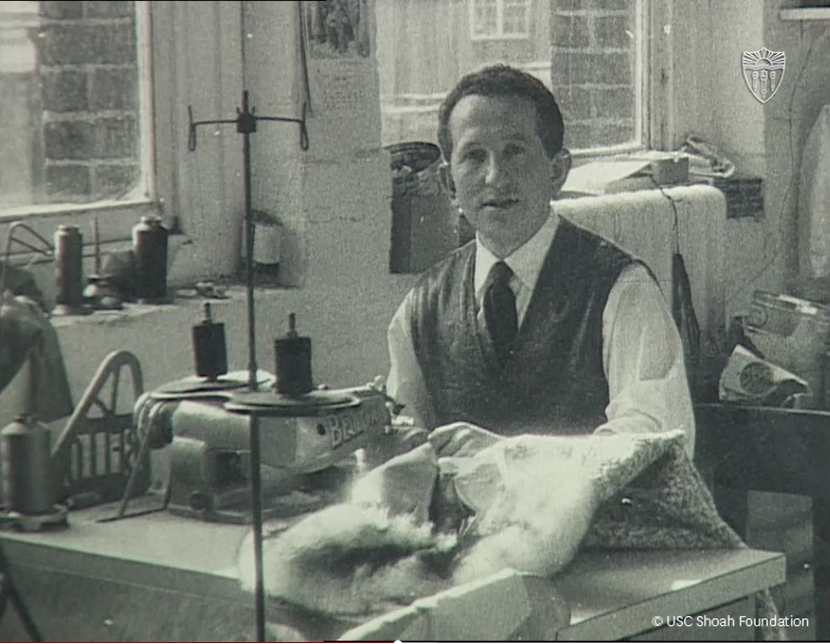
Chaim Fuks (Harry Fox) at work.
For a full list of Critical Thinking Questions click here.
Glossary
Central British Fund (CBF) The UK-based charitable organisation that was instrumental in bringing the Boys to the UK. Formerly known as the Central British Fund for German Jewry, it is known today as World Jewish Relief.
Hostel The locations in the UK where the Boys were received and given time, space, health care, and education necessary for rehabilitation, recovery, and learning English.
Kindertransport Literally ‘children’s transport’ in German. A pre-war programme whereby the British government allowed the admission of almost 10,000 mostly Jewish child refugees from central Europe after Kristallnacht until the outbreak of war curtailed the operation.
Zionism Zionism is the name given to the national movement of the Jewish people. Zionists believe that Judaism is not just a religion, but also a nationality and that Jews should have their own state in their ancestral homeland, Israel.
For a full Glossary click here.
 About
About History
 Education
 Quilts
 FIlms
FIlms Photos
 News Media & Events
 Publications
 Donate