Members of the Boys were born in Slovakia.
The Boys were teenage and child-Holocaust survivors, who were brought to the UK after the war for rest and rehabilitation.
Members of the Boys were held in Nazi labour and concentration camps and used as slave labourers. They had also survived World War II in hiding or as lone children.
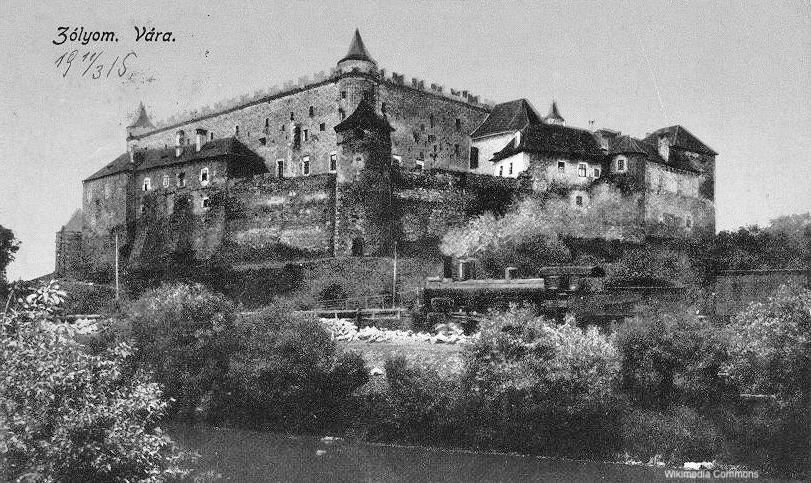
Old Picture of Zolyom Var.
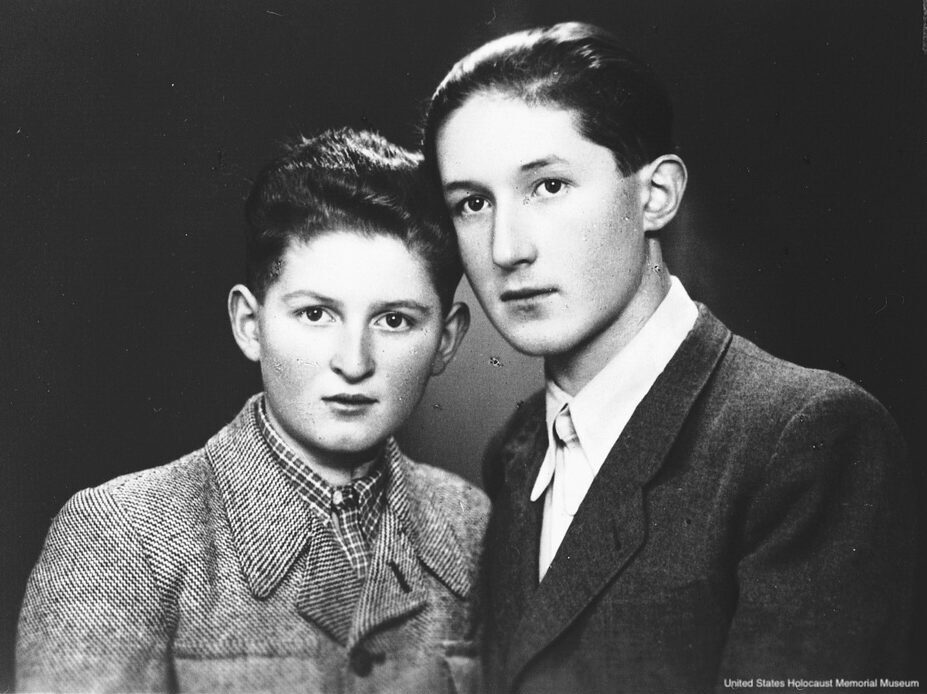
Background
Jewish life in the so-called Czech lands of Bohemia and Moravia, part of the Kingdom of Austria, was markedly different to that in Slovakia and the Carpathians, which were part of the Kingdom of Hungary. In Bohemia and Moravia, most Jews spoke German as well as Czech. They were highly assimilated, and Bohemia had the highest rate of mixed marriage in Europe. By contrast, in Slovakia, Jews were Orthodox and spoke primarily Hungarian. Before World War I, Slovak nationalists associated them with Hungarian control and in the interwar period with the new Czechoslovak state.
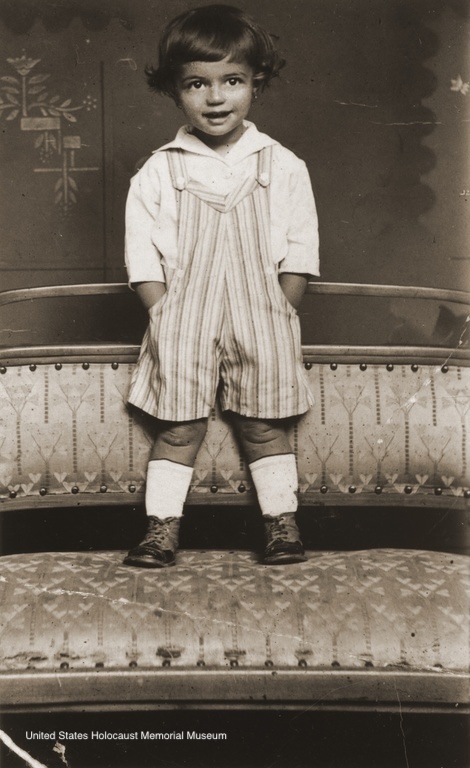
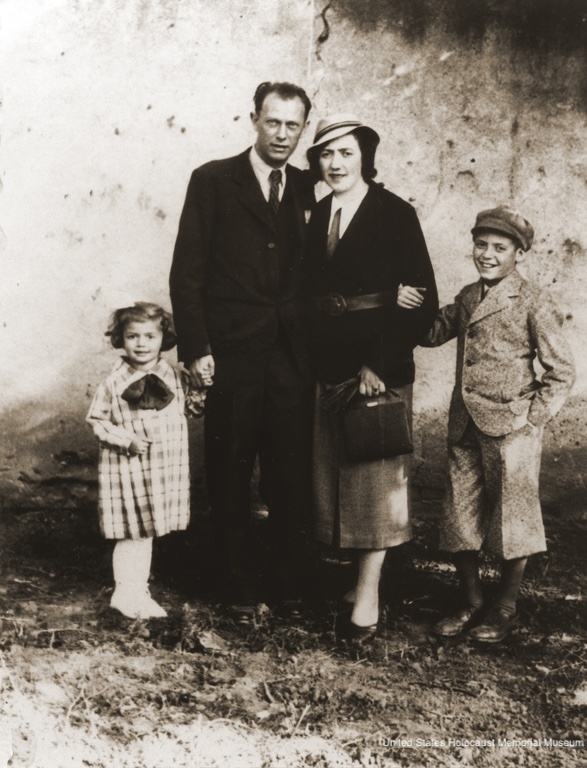
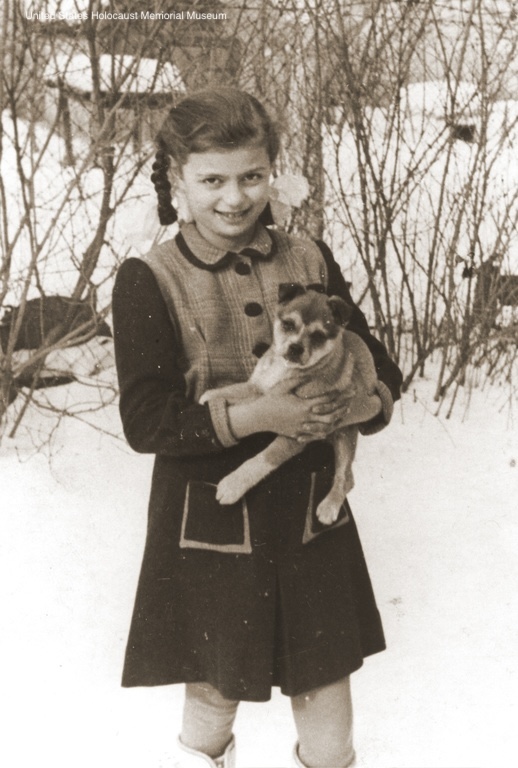
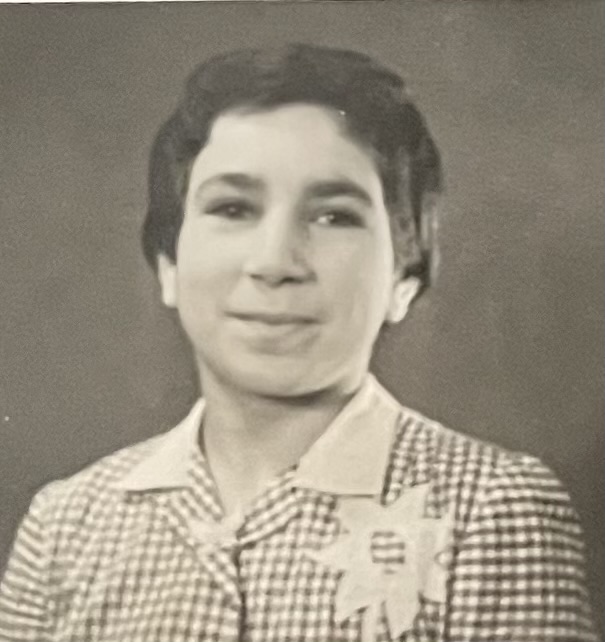
Aladar and Hemena Vermes lived in the Slovakian city of Topolciany. Aladar Vermes was a studio photographer and Helena, who was an opera singer. They had two children Robert and Erika.
On 27 March 1942, members of the Hlinka Guard, a fascist Slovak organisation, rounded-up the Jewish men in Topolciany, including Aladar and Robert Vermes, who were then deported to the Majdanek concentration camp in occupied Poland, where they were subsequently killed. Two months later, the Hlinka Guard returned to round up the women of Topolcany, however the guard who was assigned to the Vermes’ apartment realised that he knew Aladar Vermes and allowed Helena and Erika to escape.
They fled across the border to Hungary where they settled in Budapest, where Helena had been born there and was therefore able to obtain a work permit. Helena put her daughter in a local Jewish orphanage. After Germany occupied Hungary in March 1944, Erika was given false Hungarian papers with the name Erika Virag. These documents allowed her to move freely, however she remained at the orphanage, as she had nowhere else to go.
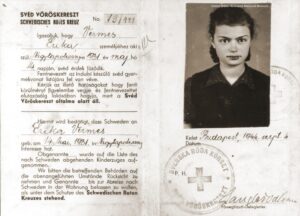
Protective document issued to Erika Vermes by the Swedish Red Cross in September 1944 in Budapest, Hungary.
In September 1944, Erika obtained a Swedish Red Cross Schutzpass (protective document) that granted her immunity from deportation. However, the pass did not protect her from being arrested by members of the Hungarian Arrow Cross (a fascist, far-right political party) who were rounding up groups of Jews and shooting them along the banks of the River Danube in November and December of 1944.
Erika was captured in a Hungarian Arrow Cross round up and was taken to the Danube, however she managed to escape due to heavy Russian bombardment of the city, which led to the liberation of Budapest in January 1945.
While Erika was at the orphanage, Helena was deported to Feldbach, a slave labour camp in Austria. After the liberation, Grossman met her mother by chance on a street in Budapest. They returned to Topolciany. However, Helena soon moved back to Budapest to marry Imre Berczeller, who had been part of the same death march that Helena had endured taken on.
Despite the war being over, there was an anti-Jewish pogrom in Topolciany which led Helena, Imre and Erika to move to Sudety in western Czechoslovakia. When they arrived, they learnt about the orphans’ transport to England, which accepted Grossman despite the fact that Erika was not officially an orphan. To read more about Erika Vermes click here.
Interwar Years
Between the two world wars, Czechoslovakia was a comparatively stable, liberal democracy in which Jews were recognised as a distinct ethnicity in the census. A Czech Jewish identity began to emerge. In the 1930 census, 356,830 people identified themselves as Jews by religion: 117,551 in Bohemia and Moravia, 136,737 Slovakia and 102,542 in Subcarpathian Rus.
In 1918–20 during the Paris Peace Conference, anti-Jewish riots broke out across the country as nationalists attacked Jewish communities they regarded as pro-Austrian or pro-Hungarian; and again in Slovakia in the 1930s encouraged by the Slovak People’s Party. Jewish boxers and wrestlers took to the streets to defend their communities, a move that prompted the wrestler Imi Lichtenfeld (1910–98) to set up the Krav Maga movement, a form of simple martial arts, so Jews could defend themselves.
1938-1945
After the September 1938 Munich Agreement, Slovakia declared its autonomy from Czechoslovakia, but lost significant territory to Hungary in the First Vienna Award, signed in November.
In 1939, Slovakia became an independent state under the leadership of Jozef Tiso (1887–1947), a Catholic priest and Slovakian politician. Significantly, Slovak state propaganda blamed the Jews for the territorial losses.
Slovakia joined the Axis powers in 1940. A ‘Jewish Code’ similar to the Nuremberg Laws was proclaimed in September 1941 and the country became the first Axis partner to agree to the deportation of its Jews, for which it was paid. Between March and October 1942, the Hlinka Guard (the paramilitary wing of the Slovak People’s Party), alongside Slovak police and military personnel, concentrated 58,000 Jews in labour camps, mainly in Novaky, Sered and Vyhne. They then transported them to the border with the General Government in occupied Poland, where they handed them over to the SS.
Out of 89,000 Jews in the country in 1940, around 69,000 were murdered in the Holocaust.
Aftermath
After the war Bratislava and Košice became important centres where survivors gathered.
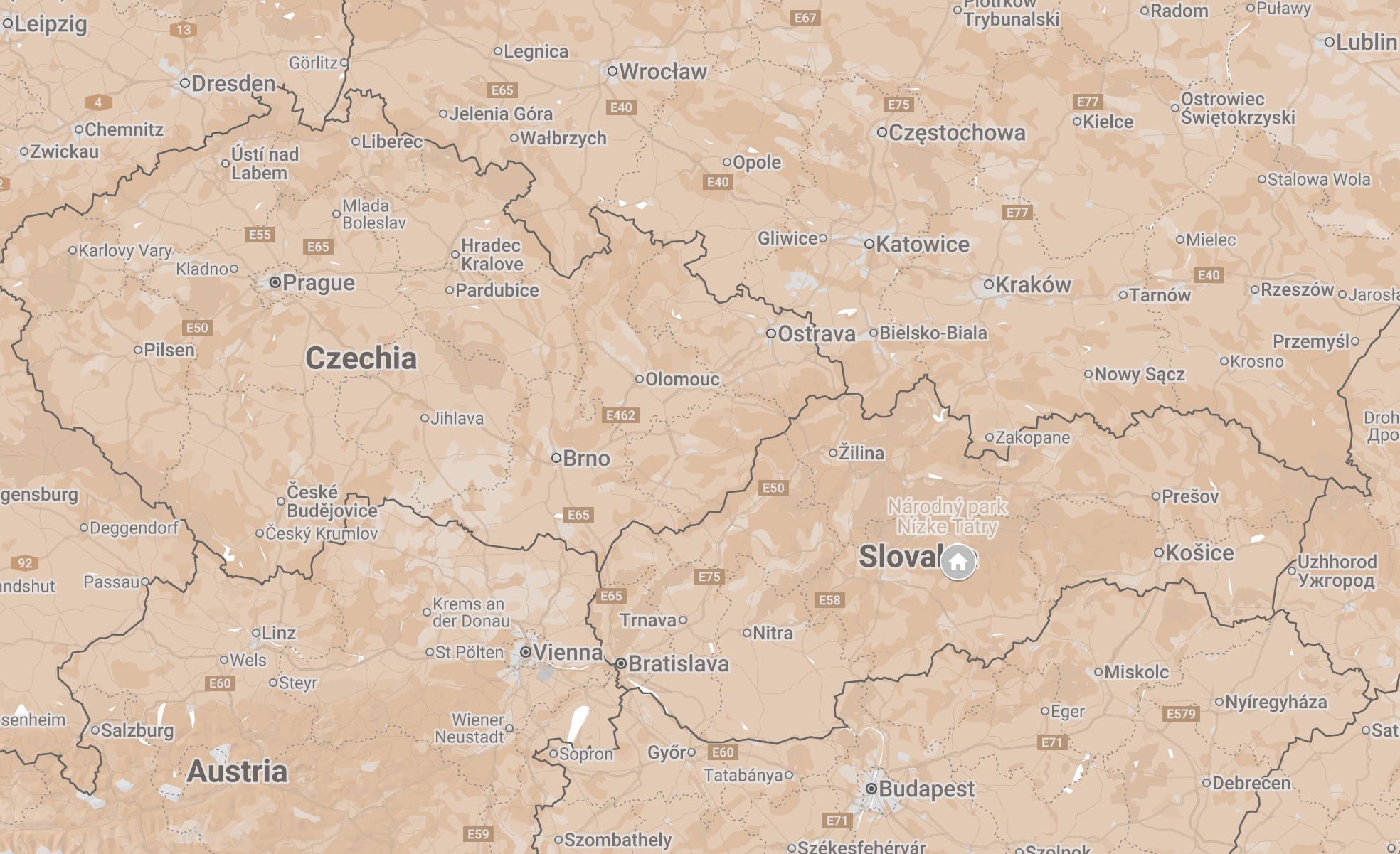
For information on getting to Slovakia and for the main sites in the principal cities click here Bratislava and Košice.
The other main Holocaust sites in Slovakia are:
Sered
Slovakia has only one Holocaust museum, in Sered, 67km northeast of Bratislava, at the site of the former Sered concentration camp.
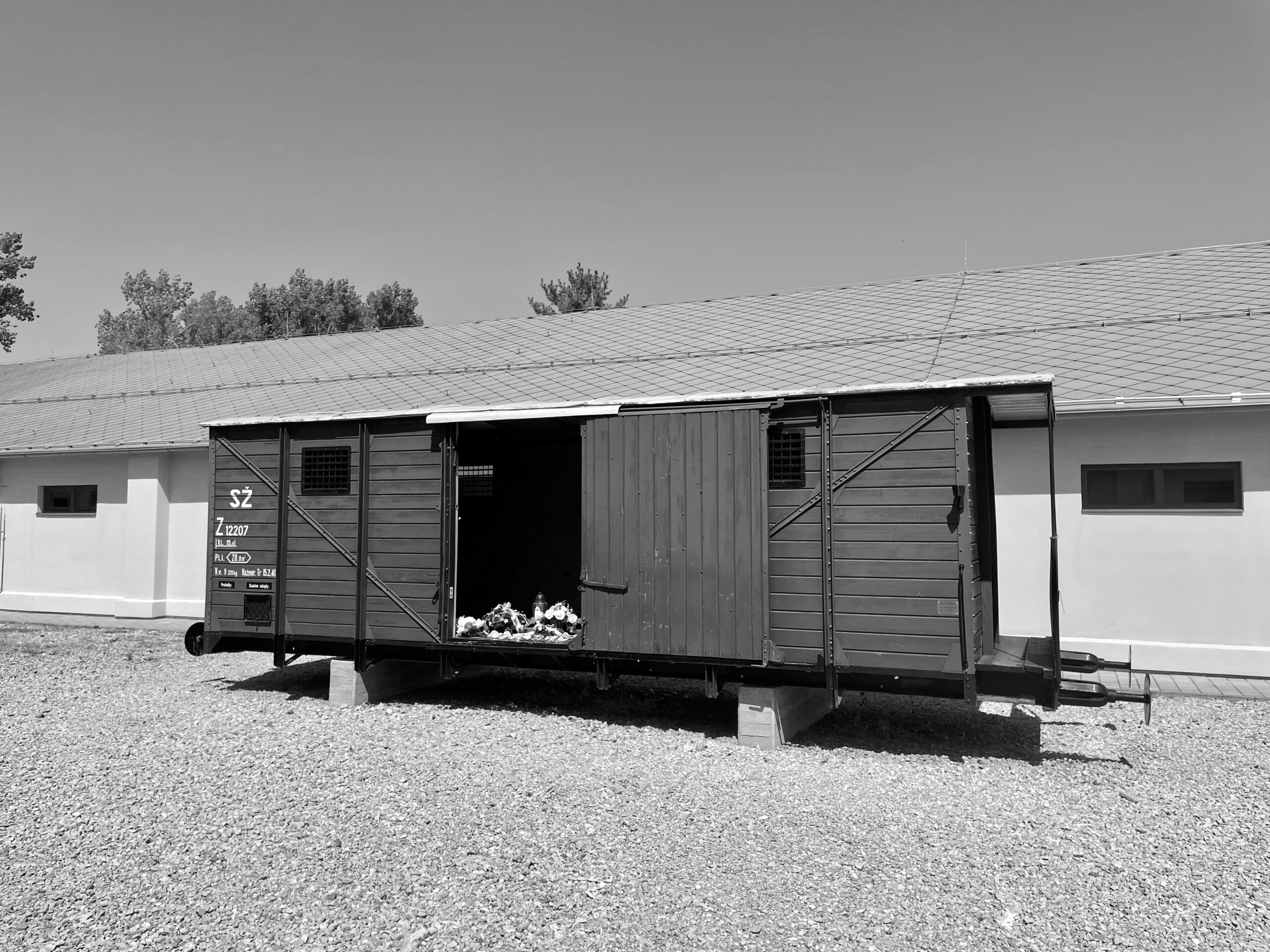
Sered Holocaust Museum, Slovakia.
To find out more about the history of the camp click here.
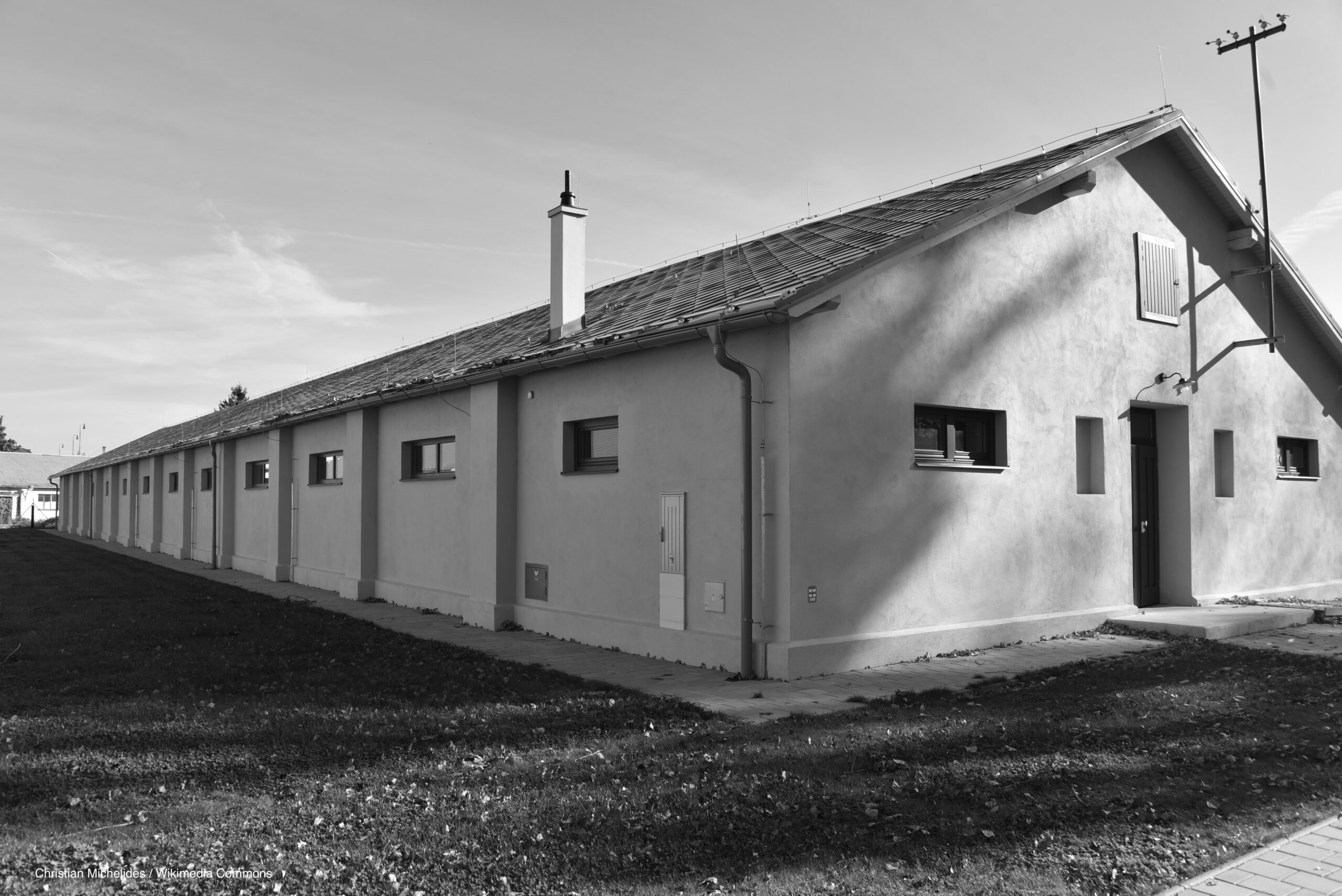
Sered Holocaust Museum (Múzeum holokaustu v Seredi; Kasárenská 1005/54; entry fee) opened in 2016, and the exhibition is modern and informative. Five of the original barracks have been reconstructed, the first dedicated to the years 1938–45, during which Jews were persecuted by the independent Slovak state. The names of victims deported in 1942 are engraved on glass panels. There is a section of the exhibition dedicated to the Slovak National Uprising and the role played by the Jews.
Between the first and second barracks is an original freight wagon which was twice used in transports to Auschwitz. The museum bought it off a private owner, who had used it as a garden shed having inherited it from his father who worked on the railways. There are original carvings inside.
The remaining barracks have exhibitions on forced labour, life in the Sered camp and the extermination camps to which Slovakia’s Jews were sent.
Nitra The city is 30km west of Sered, the synagogue (Pri synagóge 3), built in 1911, stood derelict after the war until 2003, but is now a concert hall. In what was the women’s gallery, there is an exhibition about the Jews of Nitra. A plaque outside remembers the 6,000 Jews who were deported from the town and the surrounding area.
Topol’čany The city located 33km north of Nitra saw little antisemitic violence until in 1938, however, the city became a bastion of the right-wing Slovak People’s Party.
After the war, about 750 survivors, some entire families, returned to Topol’čany having hidden out with partisans in the mountains. In September 1945 Topol’čany was the scene of a serious pogrom, in which 47 survivors were injured and 15 seriously hurt. The riot was probably caused by fears that returning survivors would reclaim their property, which had been confiscated.
A documentary shown on Slovak television in 2004, Love Thy Neighbour, prompted the mayor of Topol’čany to offer an apology. Walter Fried, who had survived the violence, erected a plaque on the former synagogue in 1998. As with the pogrom in the Polish city of Kielce, the violence prompted survivors to leave the country. No Jews live in Topol’čany today.
Prešov In 1938, Prešov, 38km north of Košice, was home to 4,300 Jews among them Erwin Buncel and his family.
Museum of Jewish Culture (Múzeum židovskej kultúry; Okružná ulica 32) in the newly renovated synagogue has a memorial to the 6,000 Jews who were deported from Prešov and the surrounding areas. There is also a memorial plaque on the town hall.
A Transport of Girls
The first transport of Jews from Slovakia destined for Auschwitz left from the railway station in the holiday resort town of Poprad-Tatry in the High Tatra Mountains 112km northwest of Košice. The transport that left the station on ul. Wolkera on the morning of 25 March 1942 was unique as it was made up of 999 unmarried Jewish young women aged between 16 and 36. They had volunteered for government service and left home dressed in their best clothes, happily waving goodbye to their families, believing they were being sent to work in a factory. In Poprad, they were held in the transit camp for almost a month, where they were fed starvation rations. Only a handful of the women would survive the war.
Heather Dune Macadam told their story in The Nine Hundred: The Extraordinary Young Women of the First Official Jewish Transport to Auschwitz (Citadel Press, 2019). A memorial ceremony is held at the railway station every year on 25 March.
 About
About History
 Education
 Quilts
 FIlms
FIlms Photos
 News Media & Events
 Publications
 Donate