
Vegh was a member of a group of Holocaust survivors known as the Boys, despite the fact the group consisted of over 200 girls.
The Boys were teenage and child-Holocaust survivors, who were brought to the UK after World War II for rest and rehabilitation.
Members of the Boys were held in Nazi labour and concentration camps and used as slave labourers. They had also survived World War II in hiding or as lone children.
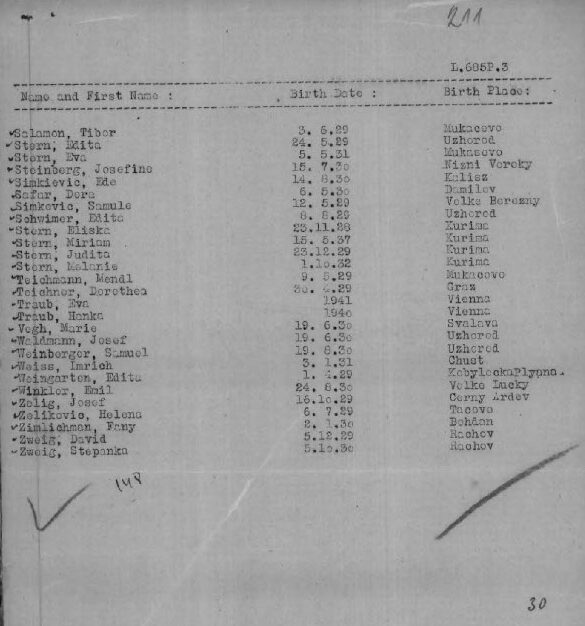
List of the Boys in the Third Group of the Boys, 1946.
[/um_loggedin]
Vegh’s parents were Raizel and Zev and he had a sister called Ester.
In 1941, Czechoslovakia was invaded and occupied by Hungary. Rachov was renamed Raho, and Vegh started attending a Hungarian school.
Slave Labour
In 1944, Vegh and his family were deported to the Mátészalka Ghetto and from there to Auschwitz II-Birkenau concentration and extermination camp. His mother and sister were gassed on arrival and he was separated from his father, who was subsequently shot.
He was a slave labourer in Auschwitz, spending ten hours every day in a coal mine.
He was then sent on a death march to Buchenwald concentration camp in Germany. Many people died on the march but he survived by continuously sucking on the snow.
At Buchenwald he was ordered to drag a wagon around the camp, collecting corpses and stacking them in the crematorium.
Liberation
On 15 April 1945 Vegh was liberated at Buchenwald by US forces.
He stayed at the camp for six weeks until he recovered and returned to Prague in search of his family.
Maurice Vegh’s Journey 1944-1948
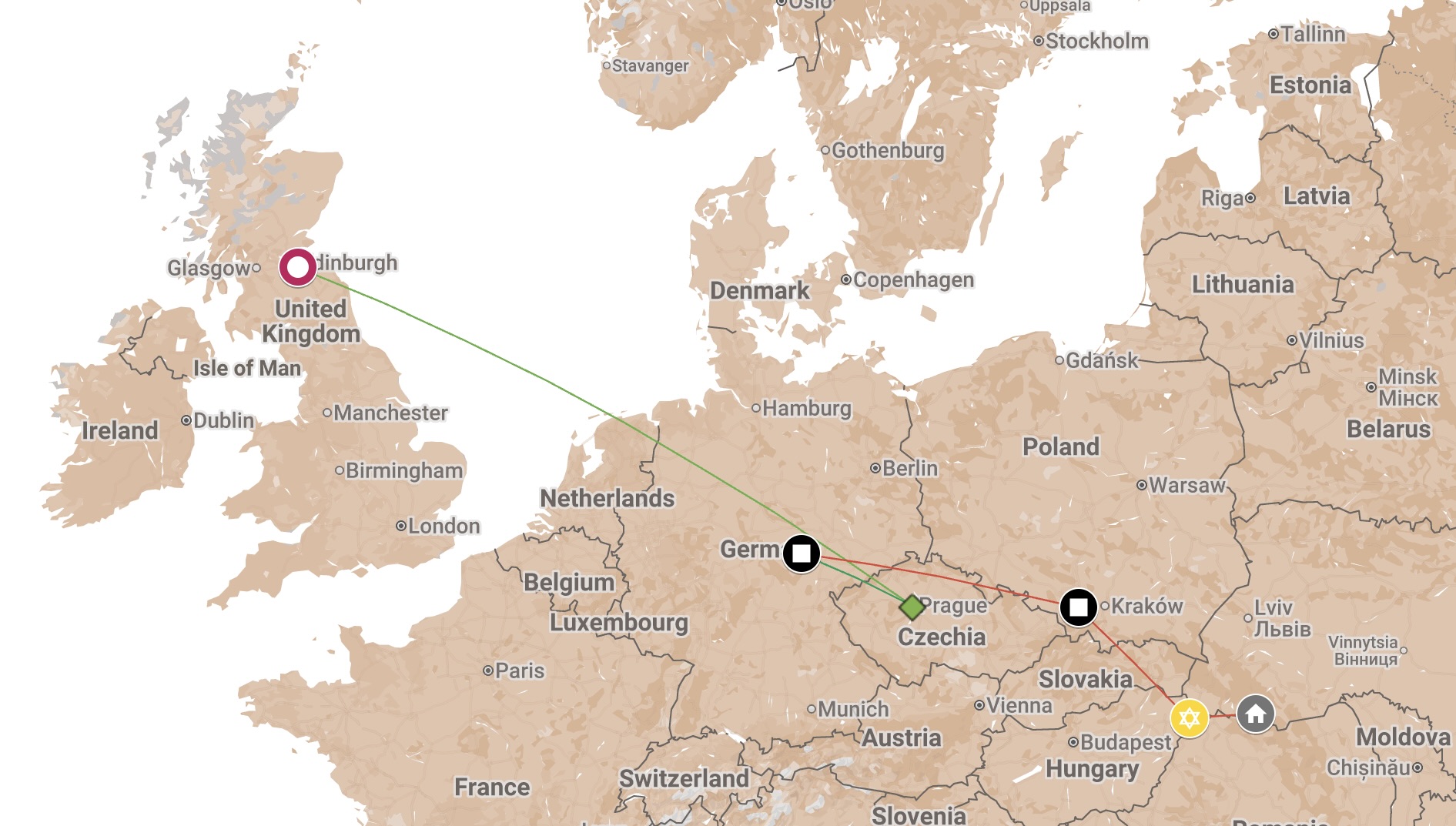
Pre-war Life: Rachov, Czechoslovakia. Forced journey: → Mátészalka Ghetto → Deportation to Auschwitz-Birkenau concentration camp → Buchenwald concentration camp → Liberation at Buchenwald. After liberation: → Prague, Czechoslovakia → Joins 3rd Group of the Boys → Lasswade, Scotland, UK.
A New Life
Vegh was brought to the UK in February 1946 in the third group of the Boys. He stayed in Polton House hostel which was a Zionist training farm, in Lasswade, Scotland, 12km south of Edinburgh.
Vegh went to the USA and was drafted into the army in the 1950s during the Korean war. He was proud to be an American soldier because it was American troops that had liberated him.
He settled in Long Island, USA with his wife and three children and worked as a hairdresser.
[/um_loggedin]
 About
About History
 Education
 Quilts
 FIlms
FIlms Photos
 News Media & Events
 Publications
 Donate