The Central British Fund (CBF) put together a large team of people to look after the Boys.
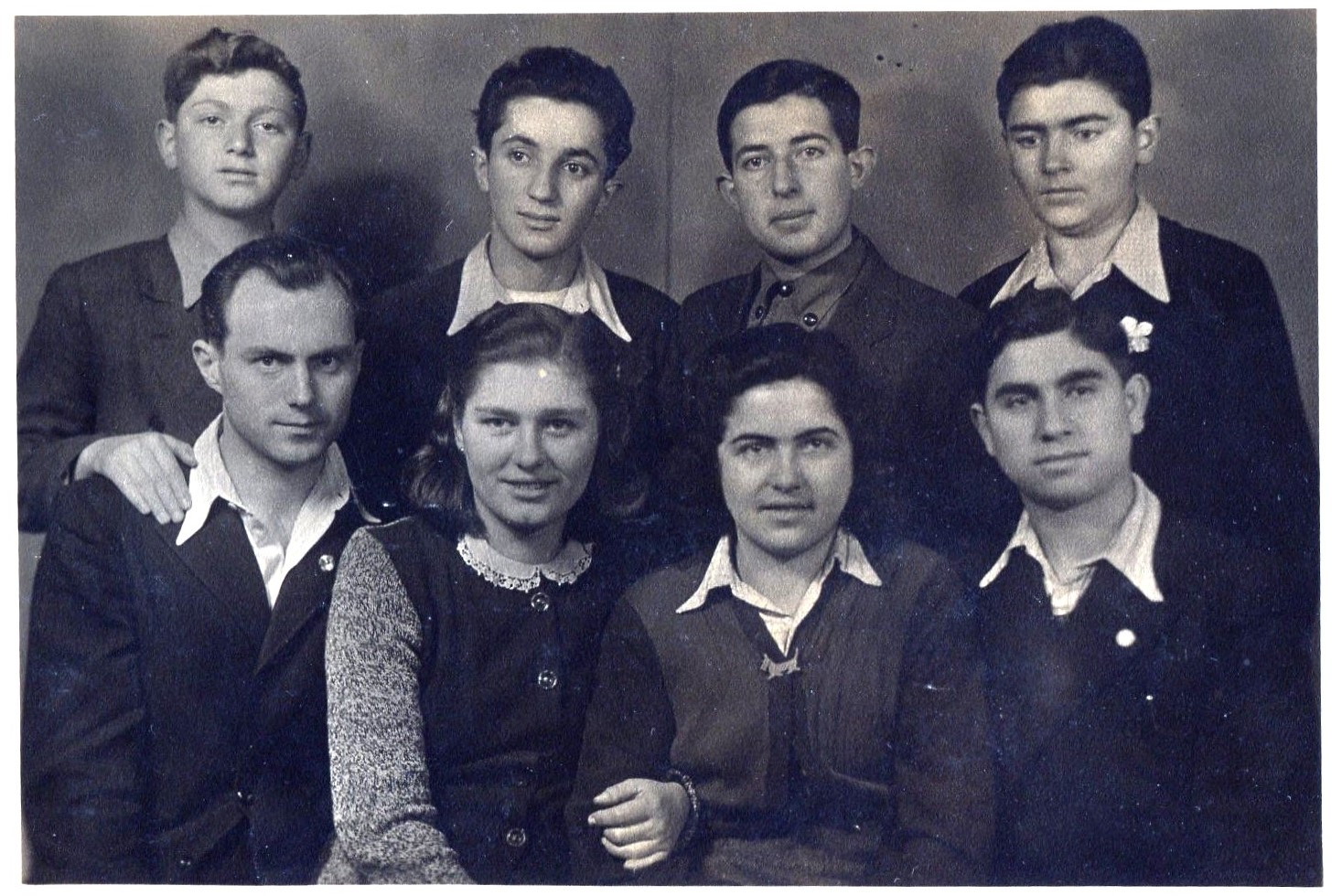
The Boys were teenage and child-Holocaust survivors, who were brought to the UK after the war for rest and rehabilitation.
The British government offered 1,000 visas to bring the Boys to the UK but the caveat was that the CBF were responsible for their care and would pay all the expenses.
Essinger was born on 15 September 1879 in Ulm, Germany in a non-observant Jewish couple. She was the oldest of nine children.
At age 20, Essinger moved to Nashville, Tennessee to attend university. There she also began a life-long association with the Quakers. Funded by the Quakers, she returned to Germany in 1919 to set up public kitchens to provide children with a hot meal a day.
Essinger worked with her sister Klara, who had set up an orphanage in Herrlingen for ‘problem children’ and by 1926, they turned it into a private boarding school called Landschulheim Herrlingen, with Essinger as headmistress.
Essinger ran the school following the Montessori method with a strong focus on community, mutual respect between teachers and students and a shared sense of responsibility. She was known to enforce strict discipline and was described as ‘stout and stern’, yet she cared deeply for the best interests of the children in her care, who all called her Tante Anna (Aunt Anna).
When Hitler came into power, when the school buildings were required to fly the Nazi flag for Hitler’s birthday, Essinger took the children on a day trip so that they would not have to see the flag. She quickly realised the dangers posed by the Nazis, and secured permission from the parents of 66 children to relocate the boarding school to southern England in 1933. It became the Bunce Court School.
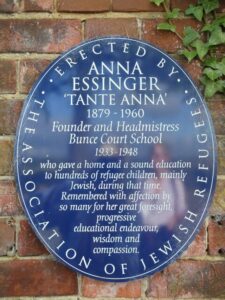
Before the outbreak of World War II, Essinger was asked to set up a reception camp in Dovercourt which received over 10,000 Jewish-German children arriving on the Kindertransport. She sought out families and homes to take in the refugee children and managed to take some of them into her school.
In 1940, the school was forced to evacuate to Shropshire, and they were not able to return to Bunce Court until 1946. Esther closed the school and retired in 1948 once the Jewish refugees had all been placed in hostels or British family homes.
Despite helping thousands of refugees to find safety in the UK, Essinger described the process as a ‘cattle market’ that allowed attractive children to be chosen first. She found running the camp and placing children in homes extremely difficult, and refused to talk about it after the war.
In 1959, on Essinger’s 80th Birthday, Bunce Court alumni planted a grove of trees in Israel in her name. Essinger died in Kent on 30 May, 1960.
In 1990, a secondary school in Ulm was named after her and a plaque placed on Bunce Court. In 2004, Essinger was added to the Oxford Dictionary of National Biography, which is highly unusual for a naturalised British citizen.

 About
About History
 Education
 Quilts
 FIlms
FIlms Photos
 News Media & Events
 Publications
 Donate