Members of the Boys were slave labourers in the Mühldorf labour camp, a subcamp of the Dachau concentration camp in Bavaria, Germany.
Dachau concentration camp was operated by Nazi Germany. The camp had 140 subcamps.
The Boys were teenage and child-Holocaust survivors, who were brought to the UK after the war for rest and rehabilitation.
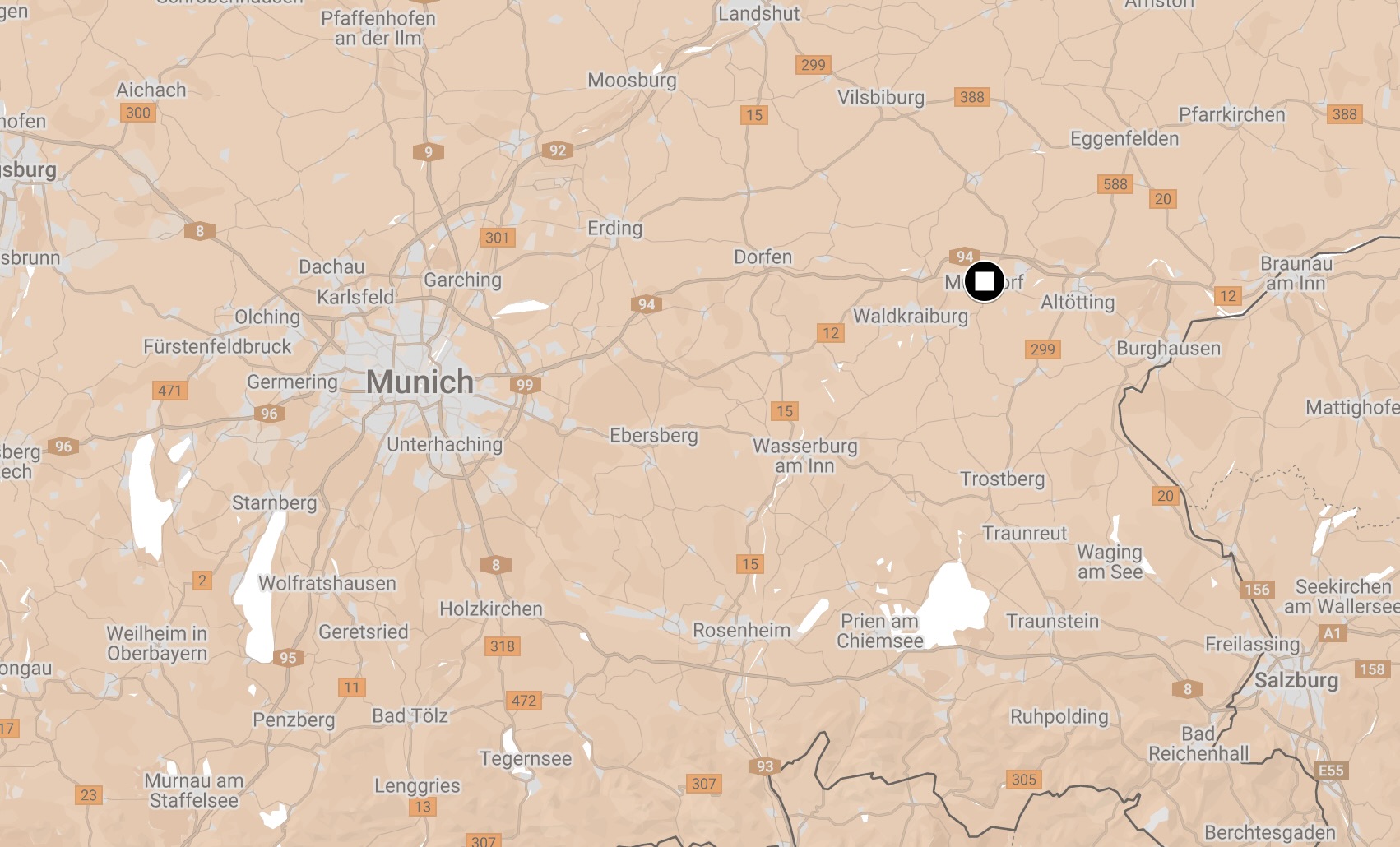
Mühldorf was established in the summer of 1944. The complex was located near the town of Müldorf in Bavaria.
The camp was created as part of a Nazi plan to construct underground installations to produce weaponry and related war material in factories that were safe from Allied bombing raids.
Under the cover of thick pine forests, the prisoners worked as slave labourers in the construction of underground installations that produced Messerschmitt Me 262 fighter jets. Prisoners frequently worked 10 to 12 hour days hauling heavy bags of cement and carrying out other arduous construction tasks. The average life span for a prisoner was 80 days.
History
The Mühldorf camps, like the Kaufering subcamps of Dachau, were a new type of camp where the SS, other than with respect to guards, had withdrawn from the responsibility for the camps. The type and pace of work, construction of the camp, food, and medical care as well as the selection of the concentration camp prisoners no longer fit for work were the responsibility of the Operation Todt.
Structure
The living conditions in the Mühldorf were catastrophic. The barracks were earthen huts partially submerged in the ground with soil-covered roofs designed to camouflage them from Allied aerial reconnaissance. The interior of the huts was limited to boards with a layer of straw and a stove. There was a lack of firewood or fuel in winter, and the rain and snow penetrated the roofs of the earth huts. The prisoners had no toilets or washing facilities. As a result, typhus and typhoid fever spread quickly. After selection, prisoners were sent to Auschwitz to be gassed. It is estimated that half the prisoners who passed through the camp perished.
Dissolution & Liberation
As the war drew to a close, the Germans intended to murder all the Jewish prisoners in the Dachau subcamps of Kaufering and Mühldorf, in a plan code named Aktion Wolkenbrand – Action Fire Cloud. The plan was abandoned and in late April, as the US Army approached the camp, and the SS evacuated some 3,600 prisoners on death marches. One of the evacuation trains was bombed and 200 of the prisoners killed. The remaining prisoners were freed at the end of April 1945 or the beginning of May 1945 in Seeshaupt, Tutzing, and Feldafing am Starnberger See.
Aftermath
The commandant of Mühldorf, Walter Langleist, was tried during the Dachau Trails in 1945. He was found guilty of war crimes, sentenced to death, and hanged at Landsberg Prison on 28 May 1946.
In February 1946, the US military court in Dachau indicted 14 Nazi officials of the Mühldorf camp for crimes committed against the unarmed prisoners, including killings, beatings, torture, starvation and abuse. In May 1947, 13 of the defendants were found guilty, six were sentenced to death by hanging, two to life imprisonment, and the remainder to sentences varying from ten to 20 years; one was acquitted. Only one of the death sentences were carried out and the others commuted to prison terms.
Another Mühldorf official, George Schallermair, was hanged at Landsberg Prison on June 7, 1951. He was one of the last seven Nazi war criminals to be executed by the US authorities.

 About
About History
 Education
 Quilts
 FIlms
FIlms Photos
 News Media & Events
 Publications
 Donate