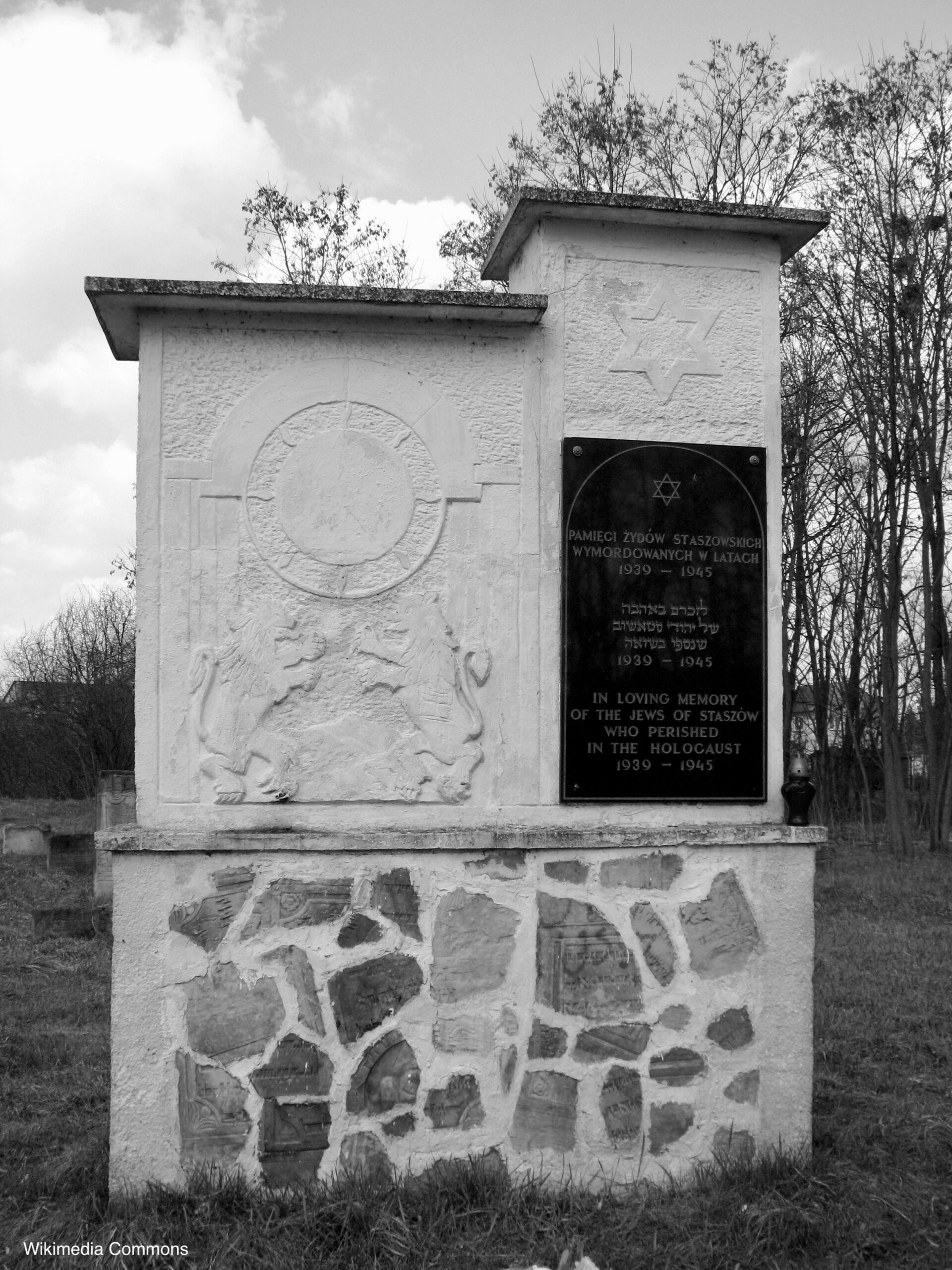
Members of the Boys were imprisoned in the Staszów Ghetto.
The Staszów Ghetto was one of a network of ghettos set up by Nazi Germany in which Jews were forced to live in occupied Poland. As with other ghettos in Czechoslovakia, Latvia, Lithuania and Poland, the Staszów ghetto was established to contain the region’s Jews and isolate them from the rest of the population until the Nazi leadership could decide on an answer to the so-called “Jewish Question.”
The Boys and their families spent years living in dire conditions. The ghettos were not designed for the vast numbers of people forced to find space to live within them. As a result, multiple families shared cramped and insanitary accommodation.
The Boys were teenage and child-Holocaust survivors, who were brought to the UK after the war for rest and rehabilitation.
Overview
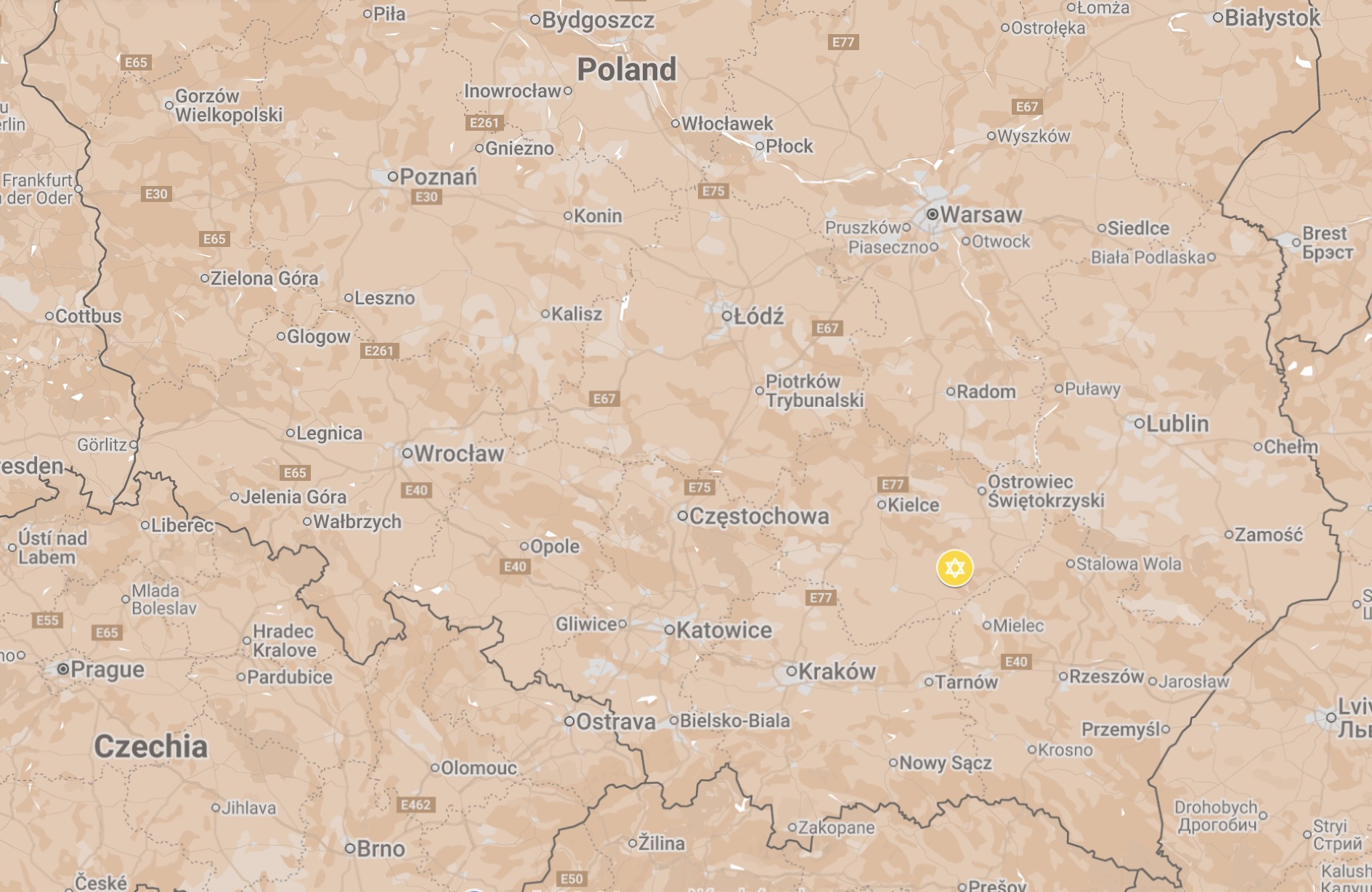
Staszów is a town 59km southeast of Kielce. A ghetto was set up in Staszów in June 1942, aiming to isolate the Jewish population from the rest of the city. To find out more about visiting the region and the Boys who grew up there click here.
Jews from Austria, Kalisz, Łódź, Sieradz, Mielec, Kurozwęki, and Szydłów were also brought into the ghetto. In late autumn 1942 about 7,000 Jews were held in the ghetto, which was liquidated on 8 November 1942.
“In December 1941, posters were hung in the street proclaiming that from 1st January 1942 no Jew could leave Staszow without the permission of the district council at Opatow and every Jew found outside the limits of the town after that date would be shot.
Things started to change rapidly I remember my uncle and all other tanners taking big risks to obtain hides for making leather. Most were purchased from the farmers and it was illegal to slaughter cows or pigs without first notifying the Germans who had taken control of most of the livestock. When they did manage to obtain some hides the farmers became partners and they took the finished leather in exchange for potatoes or corn.
Corn was the favourite exchange to make flour and bake bread. Every time we ground the corn with a little hand grinder, we had to make sure you could not be heard as it was illegal to bake you own bread. Some people got caught and the penalty the Nazis imposed on the Jews was very severe.
A week later an order was issued that the Jews had to hand over to the Germans all the fur coats they had in their possession. The collection point was at the Jewish offices and by July 1942 Staszow had a closed Ghetto. They cordoned off certain streets including that with the Synagogue, the bath alley and as far as where the tanners lived.”
Charles Shane, then Chaim Szlamberg, was 14 years old in 1941. Written testament 1995.
Layout
The ghetto consisted of one third of Staszów but did not include the market square or the main streets. The ghetto was separated into two parts. One part of the ghetto consisted of the streets: Złota, Długa, Krótka, Stodolna and Bóżnicza. The other part consisted of Rytwiańska and Kąpielowa streets. Both sections were fenced in and the gates were guarded by Polish and Jewish policemen. Contact between the two parts was possible only during two designated hours.
Daily Life
Jews from the two sections of the ghetto were permitted to meet for two hours a day, at specified times. Curfews were also introduced, starting at 6pm.
The Jews in the Staszów ghetto lived in extremely cramped conditions. The overcrowding and harsh living conditions caused widespread cases of typhus and dysentery. In an effort to alleviate the untenable situation, the Judenrat (jewish council) opened a soup kitchen but it could offer only extremely limited help. Trade with the inhabitants of the surrounding villages was limited to a minimum, although some Jews still risked their lives by leaving the ghetto to buy food. It was often young children who were given the task of taking this enormous risk to get food to feed their families.
“There was nothing to be had. There was no wood or coal to burn for heating in the bitter Polish winter. In theory we were supposed to receive a ration of food each day. It was never enough, and many times the ration did not arrive, so we were always very hungry and cold. It was a miserable existence. We never knew what to do for the best. Some people thought if they volunteered to work for the Germans they had the best chance of surviving, so in 1941 my elder brother Jonathan volunteered to work in a munitions factory in Skarżysko-Kamienna. That was the last time we saw him.”
Mayer Bomsztyk, quoted in Martin Gilbert, The Boys: The Story of 732 Young Concentration Camp Survivors (Weidenfeld & Nicholson, 1996). Bomsztyk was 14 years old in 1942.
In August 1942, tailoring workshops were set up in the ghetto to make Wehrmacht uniforms. These workshops, however, employed only 800 people.
Liquidation & Deportations
In early October, news of the deportation of Jews from nearby towns reached Staszów. Many refugees also arrived, which led to acute overcrowding and worsening sanitary conditions. At the same time a group of people were forcibly taken to the Skarżysko-Kamienna slave labour camp.
On the evening of 7 November 1942, the ghetto was surrounded by German, Ukrainian, and Latvian guards and the Polish blue police. The Jews were ordered to report to the market square at 8am the following morning.
At 10am on 8 November 1942, about 6,000 Jews were forcibly marched to the station in Szczucin. Those who could not keep up were shot. Over 700 victims were buried in a mass grave in the village of Niziny. At Szczucin, the remaining Jews were loaded into freight wagons and taken to the Treblinka extermination camp, 330km to the north.
Jewish Resistance
As rumours spread that the ghetto was to be liquidated, many Jews escaped. A handful were helped by non-Jewish Poles, others built hideouts or hid in nearby forests.
“Staszów was one of the last places to be evacuated, but myself, an uncle and a cousin, went into hiding. I was separated that day from my parents. My father said to me, ‘Let us separate, in case something happens, the chances may be better if we are not together’, and how right he was. Myself and two girl cousins and their younger brother were luckily taken to and ammunition factory in Kielce to work. The factory was called Hasag. I do know for sure what happened to my parents and younger brother. I can only assume they were shot, or sent to the gas chamber.”
Jacob Aizenburg, quoted in Martin Gilbert, The Boys: The Story of 732 Young Concentration Camp Survivors (Weidenfeld & Nicholson, 1996). Aisenburg was 13 years old in 1942.
Young people from leftist and Jewish youth groups like Hashomer Hatzair planned to organise a Jewish uprising, but the Polish Communist Party refused to provide the necessary weapons. Nevertheless, the Polish underground press recorded cases of individual attempts at resistance during the deportation action in the city.
Aftermath
After the deportation the ghetto was searched. About 450 people in hiding were murdered. The Jewish police participated in the search. The bodies of the victims were buried in a mass grave at the local Jewish cemetery. Among those discovered was Mayer Bomsztyk, who hid with his family in a cellar. They were found by the Polish police and sent to work a the HASAG labour camp in Kielce.
About 500 labourers in the workshops remained in a much-reduced ghetto until they were deported to the Treblinka extermination camp in 1943.

 About
About History
 Education
 Quilts
 FIlms
FIlms Photos
 News Media & Events
 Publications
 Donate