After liberation, members of the Boys spent months living in displaced persons (DP) camps. Many of the Boys had been slave labourers in the Nazi concentration camp system.
DP camps were temporary housing established for displaced persons and former inmates of the Nazi concentration camps. The camps were set up in Germany, Austria and Italy after World War II by the Allied forces. Belsen-Hohne was one of these.
The Boys were teenage and child-Holocaust survivors, who were brought to the UK after the war for rest and rehabilitation.
Overview
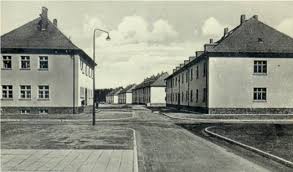
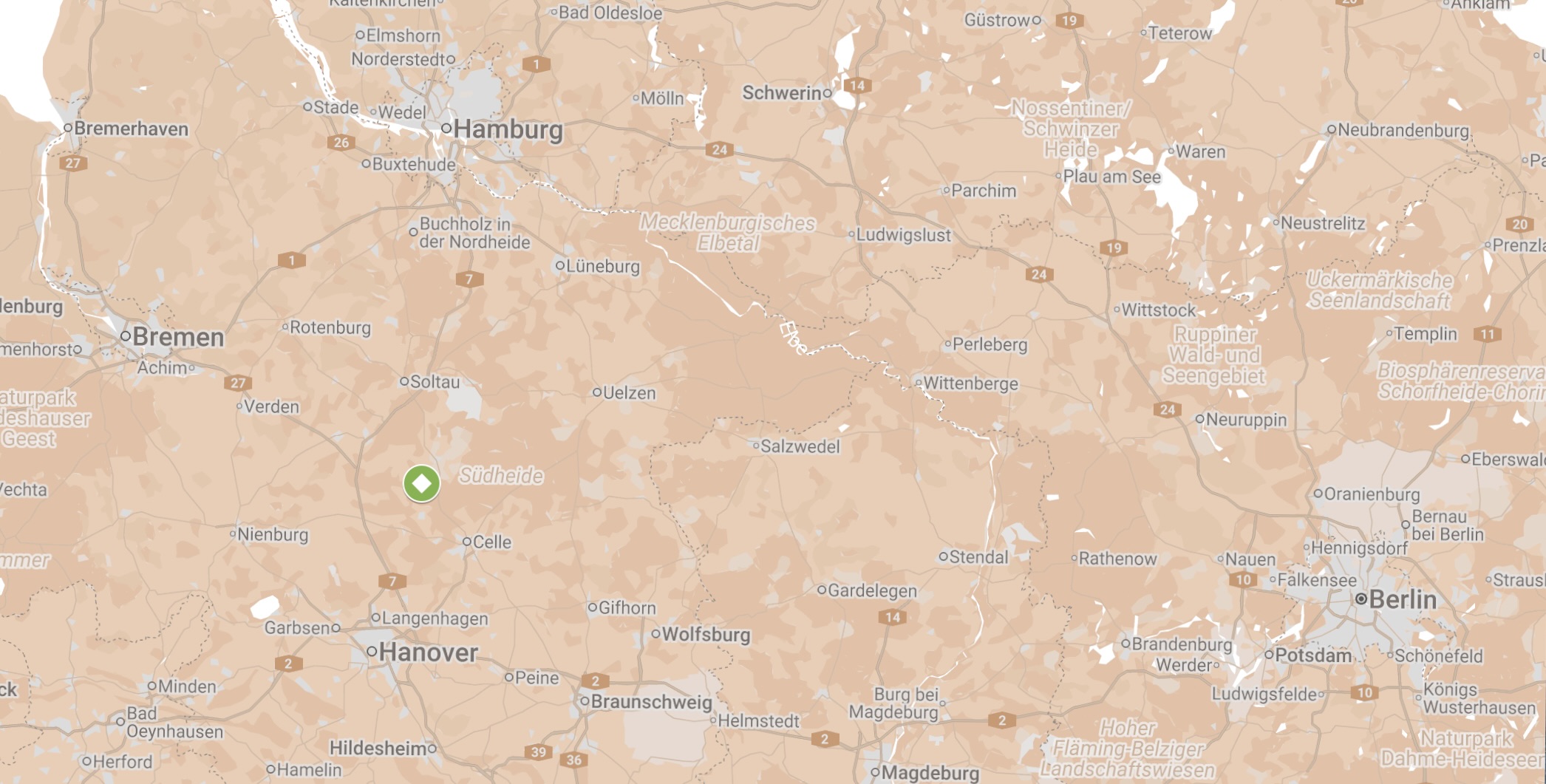
After liberation, a camp for displaced persons was set up at Belsen-Hohne, near the Bergen-Belsen concentration camp in northern Germany. The Belsen-Hohne DP camp became the largest in the British-occupied zone of Germany and remained so until its closure in 1950.
Background
The Bergen-Belsen concentration camp was liberated by the 11th Armoured Division of the British Army on 15 April 1945. It became a major news story, and the newsreels shocked people around the world. Many prisoners had been moved to Belsen from other concentration camps on a series of death marches as the Allies advanced on Germany, among them members of the Boys.
The British soldiers who entered the camp found 60,000 prisoners who were dying of disease and starvation. The conditions were appalling and there was hardly any food or clean drinking water. Half of those who were liberated died in the weeks that followed.
“When I awoke from a dreadful nightmare, there were friendly, smiling faces around me telling me it was all over. I was too numb and too confused to make sense of what they were saying. I was liberated on 15 April, but have no memory of it as I lay unconscious. When I regained consciousness, I found four portions of black bread and four tins of Nestlé’s condensed milk beside my bunk. I looked at the bread and burst out crying. I had so longed for, and dreamed of the day when I could just eat and eat, but I was too ill even to taste the food.
The first few days after liberation were joyous and yet sad, confusing and bewildering. I did not know how to cope with freedom after years of painful imprisonment. Looking out of the window, I could see German soldiers being made to clear the mountain of corpses. The inmates had to be restrained from attacking them.”
Esther Zylberberg, later Esther Brunstein, testament to the Aegis Institute, 2003.
Zylberberg was 17 years old.
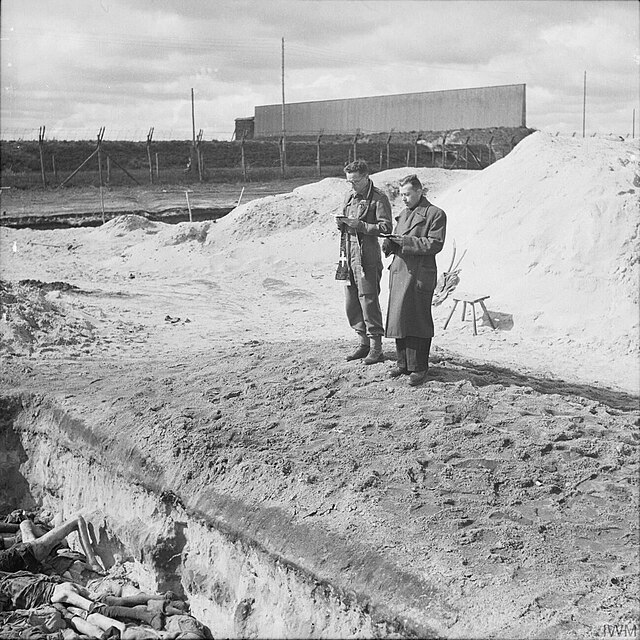
After liberation, the British Army fought to contain a severe typhus outbreak. The concentration camp was burned down in the weeks that followed. Burying the dead became a priority and was a task assigned to the former SS guards, who had still been in the camp when it was liberated.
The official Allied policy was repatriation, but many survivors had no desire to return home. Those who did were often met with hostility and found their homes occupied by neighbours or strangers. Among those who found herself on a train back to Czechoslovakia was Ruzena Slomovic, now Rachel Levy.
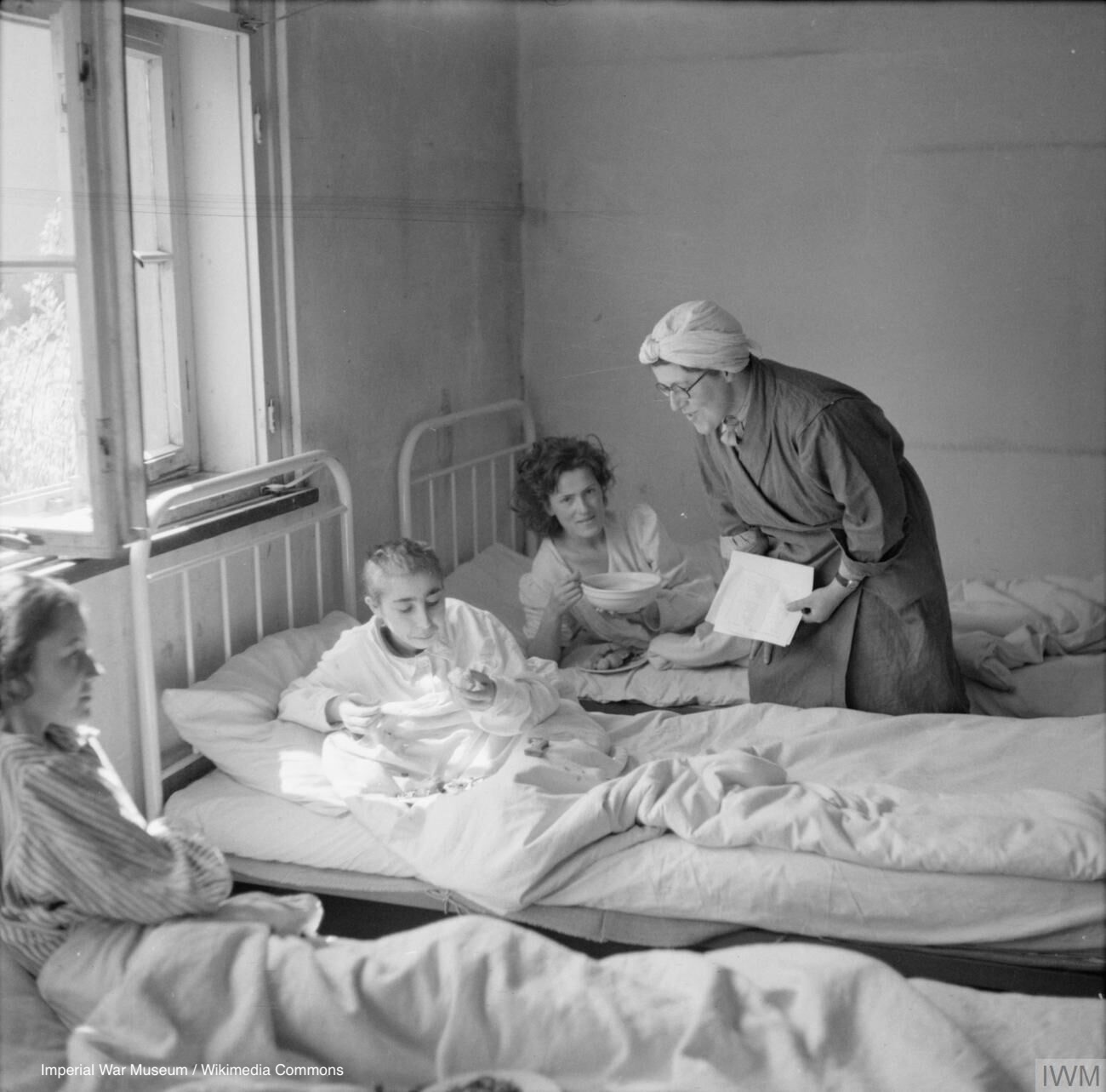
“Sometimes some of us had to have our hair cut off again because of the lice and the nits. Some [nurses] just sat there and combed the nits out and talked to us. And we got stronger. They fed us and we got better. There was a remarkable recovery … We were nursed back in a very short period of time. I wish I knew how long it was, but I don’t remember the time, don’t remember the dates or anything. But we did get better … After a while we were taken out of there and taken to Prague by train. It was then the search started.”
Ruzena Slomovic, later Rachel Levy in a testament to the Imperial War Museum, 2006.
Levy was 15 years old when she was liberated.
From Tank Barracks to Hospital
The survivors were taken to the nearby Wehrmacht barracks in Hohne, which had once been a Panzer training school. Hohne is close to Luneburg Heath, which was and still is used for battle practice. The panzers had trained at Luneburg before the invasion of the Soviet Union in June 1941.
The barracks already housed 15,133 prisoners, most transferred from the Mittelbau-Dora labour camp in the final weeks of the war. This group also included members of the Boys.
Urgent medical care was the top priority, and a hospital was set up in the new DP camp. Many of the Boys were cared for in the Children’s Hospital. At first German prisoners who had medical training were used as staff, as were survivors, who worked alongside the British Army Medical Corps and the Red Cross. Ninety-seven medical students were also sent from the UK. The first aid workers at Belsen included Quakers, and the first Jewish aid worker to arrive was Jane Leverson (later Levy).
Caring for the Children
British Army chaplains Rabbi Leslie Hardman (1913–2008) and Rabbi Isaac Levy (1916–2005) played a vital role in the care of survivors following the liberation of Bergen-Belsen on 15 April 1945, and the establishment of Belsen-Hohne DP Camp.
Liberation
Rabbi Leslie Hardman was the first Jewish chaplains to enter Bergen-Belsen after its liberation. He arrived on 17 April 194, two days after liberation, accompanied by the British 11th Armoured Division. He was confronted with scenes of unimaginable suffering and death. Hardman immediately set about comforting the dying, helping survivors pray, and overseeing the burial of thousands of victims. He conducted the first Jewish burial services in the camp, insisting that each body be treated with dignity and laid to rest according to Jewish law.
Rabbi Isaac Levy arrived soon after liberation to assist with the religious and emotional rehabilitation of survivors. Working alongside Hardman and British military authorities, Levy helped organise memorial services, distributed religious materials, and provided pastoral support to those beginning to recover from the trauma of the camps.
DP Camp
As survivors were moved from the destroyed concentration camp to the newly established Belsen-Hohne Displaced Persons Camp, both Hardman and Levy continued their work among the Jewish survivors. They helped re-establish religious life in the camp, setting up a synagogue, organising communal prayers, and supporting the work of aid workers, doctors, and rabbis. Rabbi Hardman also worked with military and relief personnel to document conditions and advocate for the survivors’ ongoing care.
Hardman and Levy called on the Jewish community to help by sending supplies and aid workers. They were frustrated that the British authorities were slow in granting the Jewish Committee for Relief Abroad’s Jewish Relief Unit (JRU) access to the Belsen-Hohne DP camp.
Legacy
Both men later returned to Britain deeply affected by their wartime experiences. Rabbi Hardman served for many years as Senior Jewish Chaplain to the British Army and as minister of Hendon United Synagogue. Rabbi Levy later became one of the most prominent religious leaders in post-war British Jewry and maintained lifelong ties with the survivor community. He went on to become the first director of the Office of the Chief Rabbi, helping shape post-war Jewish education and interfaith work in the UK.
Among the survivors who cared for the children at Bergen-Belsen and later Belsen-Holne were Josef Rosensaft (1911-1975) and Dr Hadassah (Ada) Bimko Rosensaft (1912-1997). They dedicated themselves to the care and recovery of fellow survivors including many of the Boys.
Background and Wartime
Hadassa Rosensaft (née Bimko) was born in Sosnowiec, Poland, in 1912 and trained as a dental surgeon. She was deported to Auschwitz in 1943, where she secretly tended to fellow prisoners and hid medical supplies.
Josef Rosensaft was born in 1911 in Będzin, Poland. Deported to Auschwitz in 1943, he escaped by leaping from a transport into the Vistula River, sustaining gunshot wounds. Recaptured and severely beaten, he was eventually sent through several concentration camps and survived a death march to Bergen-Belsen, where he was liberated by British forces in April 1945.
Bergen-Belsen and Belsen-Holne
In late 1944, Hadassah was transferred to Bergen-Belsen, where she took a leading role in organising medical care and in saving the lives of many inmates. In the final months of the war, she took charge of more than 150 orphaned and unaccompanied children inside the camp, caring for them until liberation
After liberation, the Bergen-Belsen survivors were moved to the new Belsen-Hohne Displaced Persons Camp, where Josef emerged as a leading organiser within the Jewish survivor community. Elected chairman of the Central Committee of Liberated Jews in the British Zone, he represented thousands of displaced persons, working closely with rabbis, doctors, and international relief organisations. He was a committed Zionist and advocated for the children’s relocation to the Palestine Mandate. Under his leadership, Belsen-Holne became the administrative and spiritual centre of the Jewish Sh’erit ha-Pletah (the surviving remnant).
Josef met Hadassah at Belsen-Holne. She was formally put in charge of the camp’s wounded and later of the emergency children’s care, helping to keep hundreds of children alive through the immediate post-liberation crisis, among them many of the Boys. Hadassah organised teams of survivor doctors and nurses, establishing children’s wards and speaking publicly about camp conditions. Josef organised the camp administration and also conducted international lobbying on immigration and restitution.
They married in the camp in 1946 and later had a son, Menachem, who became a noted writer and advocate for Holocaust remembrance.
Aftermath and Legacy
After the closure of the DP camps in 1950, the couple moved to Switzerland before relocating to the United States. Josef moved into the art and real-estate business. He founded and served as president of the World Federation of Bergen-Belsen Survivors. In 1970, he led a delegation of 200 former inmates to the site to mark the 25th anniversary of liberation. He was renowned for his commitment to Holocaust remembrance, declaring that he would “never forget and never forgive.”
Mala Tribich later said that Bimko saved her life. Tribich was in a group from the Belsen DP camp who were taken to recuperate in Sweden, and she came later to the UK to join her brother, Ben Helfgott, also one of the Boys.
Josef died in London in 1975 and was buried in New York. Hadassah died in 1997 in also New York.
The Jewish Relief Unit (JRU) was the British Jewish humanitarian body deployed to Europe by the Jewish Committee for Relief Abroad. Led by Bachad activist Shalom Markovitz, the JRU urgently sought entry into Germany, particularly Bergen-Belsen, as conditions were catastrophic. Despite repeated pleas, they were not permitted to deploy in Belsen until six weeks after the liberation. They were the first Jewish civilian aid workers to arrive at the camp.
The first JRU volunteers arrived on 21 June 1945, led by Shalom Markovitz. He was instrumental in both the Boys’ care and their transfer to the UK. A second JRU team arrived shortly after, followed by a third in August. Helen Balmuth (later Bamber), who became a renowned psychotherapist and human rights activist, was among the volunteers. Also on Markovitz’s team were Eva Kahn-Minden, a nurse who later became matron of the Quare Mead hostel in the UK, and Sadie Rurka (later Hofstein), a nursery assistant and the only person to volunteer for the role of Child Welfare Officer.
The JRU cared for child survivors, organised education and welfare, supported DP camp administration, and worked closely with UNRRA and the American Jewish Joint Distribution Committee. The JRU also liaised with British hostels and briefed staff in the UK in preparation for children expected to arrive.
Sadie Rurka was a 22-year-old nursery school assistant in Britain when she volunteered for the position of Child Welfare Officer with the Jewish Relief Unit. She was the sole applicant.
Before leaving for the UK for Holland and then Germany, Rurka had been given a brief training course at the Great Ormond Street Hospital, the Tavistock Clinic and Anna Freud’s nursery. When she arrived in Belsen, 22-year-old Rurka was placed in charge of 83 unaccompanied or orphaned children under the age of 16 and became matron of the Kinderheim (children’s home), the children’s home where 47 of the Boys were cared for. Not all of the Boys in the home had been liberated in Belsen and a number, like Chaim Liss, arrived after the liberation.
Rurka spoke Yiddish with the children and was a key player in the founding of the DP camp school. The children in the school were taught in German, which was the only common language. One of the teachers was a Czech survivor Irene Mandel, who spoke five languages. It was here that one of the Boys Josef Himmelstein (later Joe Stone) learned to read and write, as he had received no schooling since the age of nine. Aid workers from the American Jewish Joint Distribution Committee were also involved in looking after the survivors.
The Boys who spent time in Belsen experienced a revival of Jewish cultural, political and religious life. Nearly all the survivors were ardent Zionists. Jewish soldiers from the British Army’s Jewish Brigade also helped out caring for the younger survivors. Chaim Liss recalled that they taught them Hebrew. The Jewish Brigade played an important part in illegal immigration to the British controlled Palestine Mandate. Many of the young survivors were inspired by seeing Jewish soldiers for the first time.
Rurka played a decisive role during the political battle over the children’s transfer to Britain. When she learned a group of her children had been approved for departure, she and the children were joyful, but Rosensaft opposed the move. In her testimony, she recalled fighting “all night long” over the issue until David Ben-Gurion, the then-chairman of the Palestine Mandate’s Jewish Agency, arrived at the camp and intervened. He persuaded Rosensaft that if the children were sent to Britain, he would personally ensure that the British government allow them to settle in Palestine.
The Lost Boys
Given that Belsen-Hohne was the largest DP camp in the British zone, it might be expected that most of the 1,000 child visas offered by the British government would go to children from Belsen. Yet only 47 child survivors from the camp became part of the Boys and that was only after a timely intervention from David Ben-Gurion, the chairman of the Palestine Mandate’s Jewish Agency.
Opinions in the DP leadership and among aid workers were divided as to where the children would build a new life. The night before the children were due to leave for the UK the head of the children’s home, Sadie Rurka, who was in favour of her charges being taken to the UK, argued late into the night with the head of the Central Committee of the Liberated Jews, Josef Rosensaft. Rosensaft, a staunch Zionist, wanted the children to settle in Palestine. He only agreed to let the children leave after Ben Gurion, who was on a visit to the camp personally, interceded on their behalf. He promised Rosensaft that all of the children would be resettled in the Palestine Mandate. The Boys who had been given visas for the UK had previously staged a demonstration and gone on hunger strike demanding that they be allowed to leave for Britain.
While the Boys were in the Bergen-Hohne DP camp Jewish survivors were classified by their country origin and were only recognised as a separate group after the Boys had left for the UK. This is clear from the list of the children who came from the British zone as they are listed by nationality unlike those of the second group who arrived at the same time from the American sector.
Shalom Markowitz returned to the UK from Belsen before the arrival of the second group of the Boys. He visited staff at Wintershill Hall to brief them. The Central British Fund then appointed Markowitz and his wife to be the wardens of a large hostel in Hemel Hempstead that was prepared to receive a subsequent group from Belsen of 220 children. This group of children never arrived in the UK as they were prevented from leaving by the Committee of the Liberated Jews, who demanded that the children settle in Palestine. The committee was supported by the rabbis in the Belsen-Hohne DP camp, who opposed the children’s transfer to the UK as some children on the pre-war Kindertransports had not been placed in Jewish homes.
The Bergen-Belsen DP camp was finally dissolved in the summer of 1950. The children who remained in the Belsen-Hohne DP camp were transferred to a children’s home in the Hamburg suburb of Balkanese. They were then taken to Israel.
 About
About History
 Education
 Quilts
 FIlms
FIlms Photos
 News Media & Events
 Publications
 Donate