Members of the Boys were held in Nazi labour and concentration camps and used as slave labourers.
From 1933-1945 Nazi Germany operated over 1,000 concentration camps and subcamps in its own territory and across German occupied Europe. Among them was the Flossenbürg concentration camp.
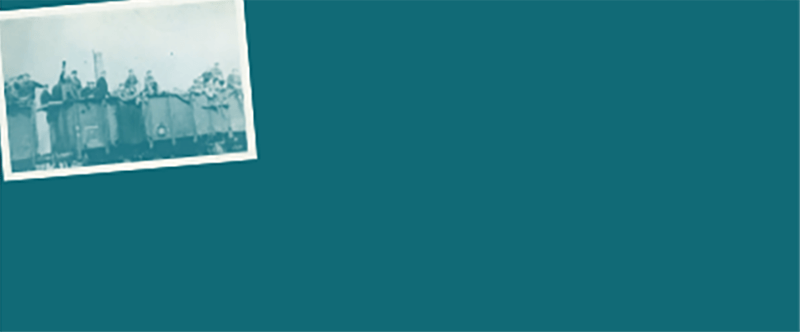
As the camps were dissolved thousands of people, among them members of the Boys, endured horrific evacuations from the camps on foot, in freight wagons and open top trains, as well as perilous journeys across the Baltic Sea.
The Boys were teenage and child-Holocaust survivors, who were brought to the UK after the war for rest and rehabilitation.
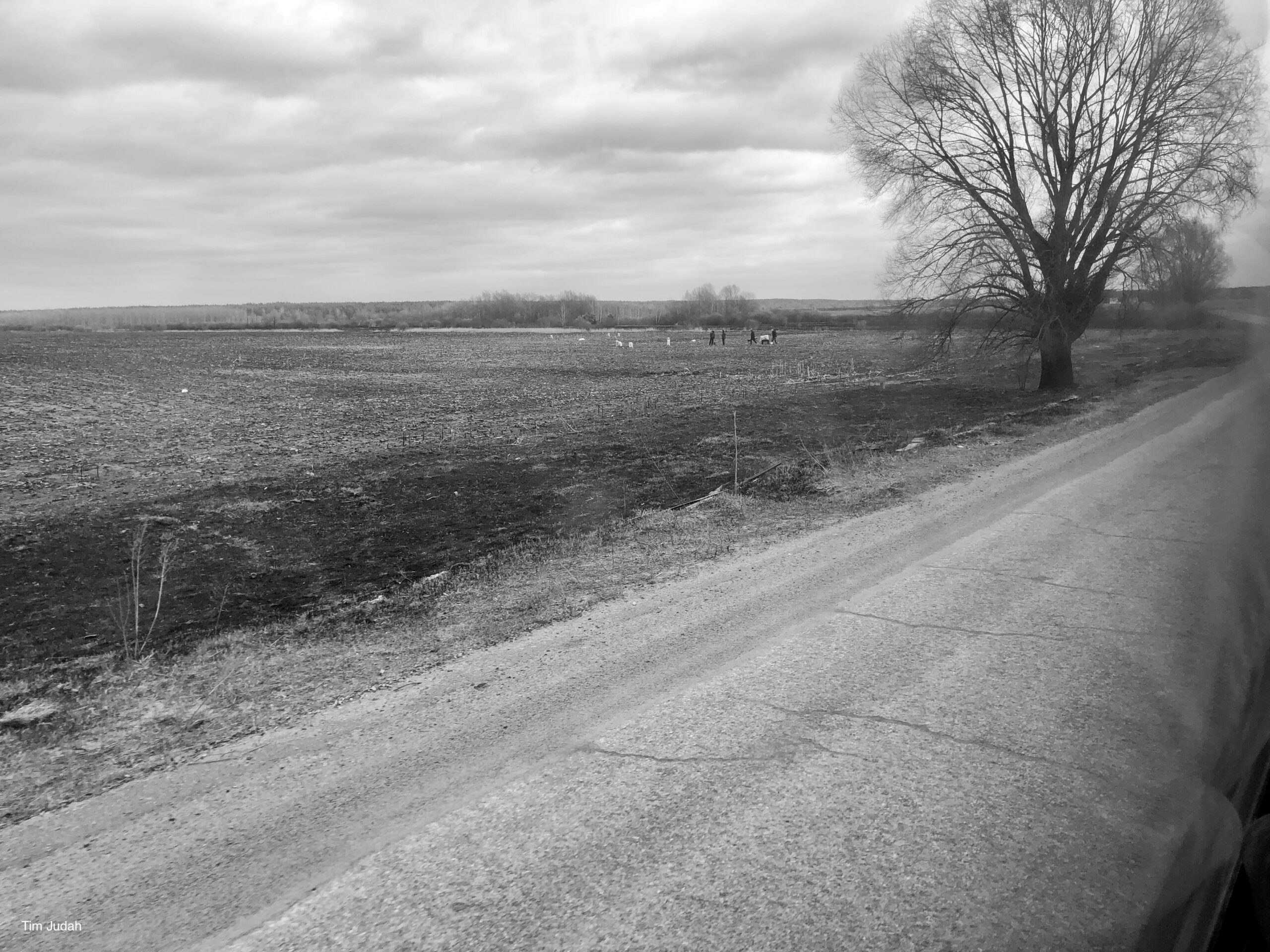
In the weeks before the evacuation, Flossenbürg concentration camp’s population had shot up dramatically as approximately 7,000 prisoners arrived who had been evacuated from other camps arrived.
As the American army approached Flossenbürg in mid-April 1945, the SS began the mass evacuation of the camp on a death march and by train to Dachau. Of the approximately 16,000 prisoners who set out on the march it is believed that 7,000 died along the route.
According to one member of the Boys, Lazar Kleinman, later Leslie Kleinman, when the trains arrived in Dachau the guards did not open the doors and the prisoners inside perished. He considered himself to be “lucky” to be on a train that was attacked by American planes and the locomotive destroyed. Many prisoners were killed or shot by the SS as they tried to escape.
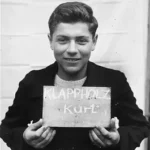
Among those members of the Boys in Flossenbürg, Kurt Klappholtz was one of those who left the camp on foot. In a testament at the Imperial War Museum he recalled:
“Now, then, of course, there were the people in whose eyes you could see impending death … It certainly made an impression on me. You could look at someone’s eyes and say, well, you know, tomorrow or whenever, he wouldn’t be here, assuming he was anywhere near you for you to notice that. But there was this peculiar stare in their eyes, very difficult to describe unless you have literary talents, which I don’t possess.
And some of those people were so weak that if we stopped by some water source, usually some small river, they would be prepared to give bread to someone to fetch them water from the river. So they must have been fairly near their end.
And then I remember noticing that people who began to show signs of complete exhaustion were suddenly surrounded by two other people who would prop them up and help them to march. And I said, well, what’s going on here? Well, the mystery was soon revealed. Those people would feel in the victim’s pockets, relieve him of his bread. And as soon as they’d done that, they would let him go. I seem to remember that I had a certain distaste for what I saw, although I suppose rationally speaking, it wasn’t exactly a crime to get the bread before the chap died.”
Route
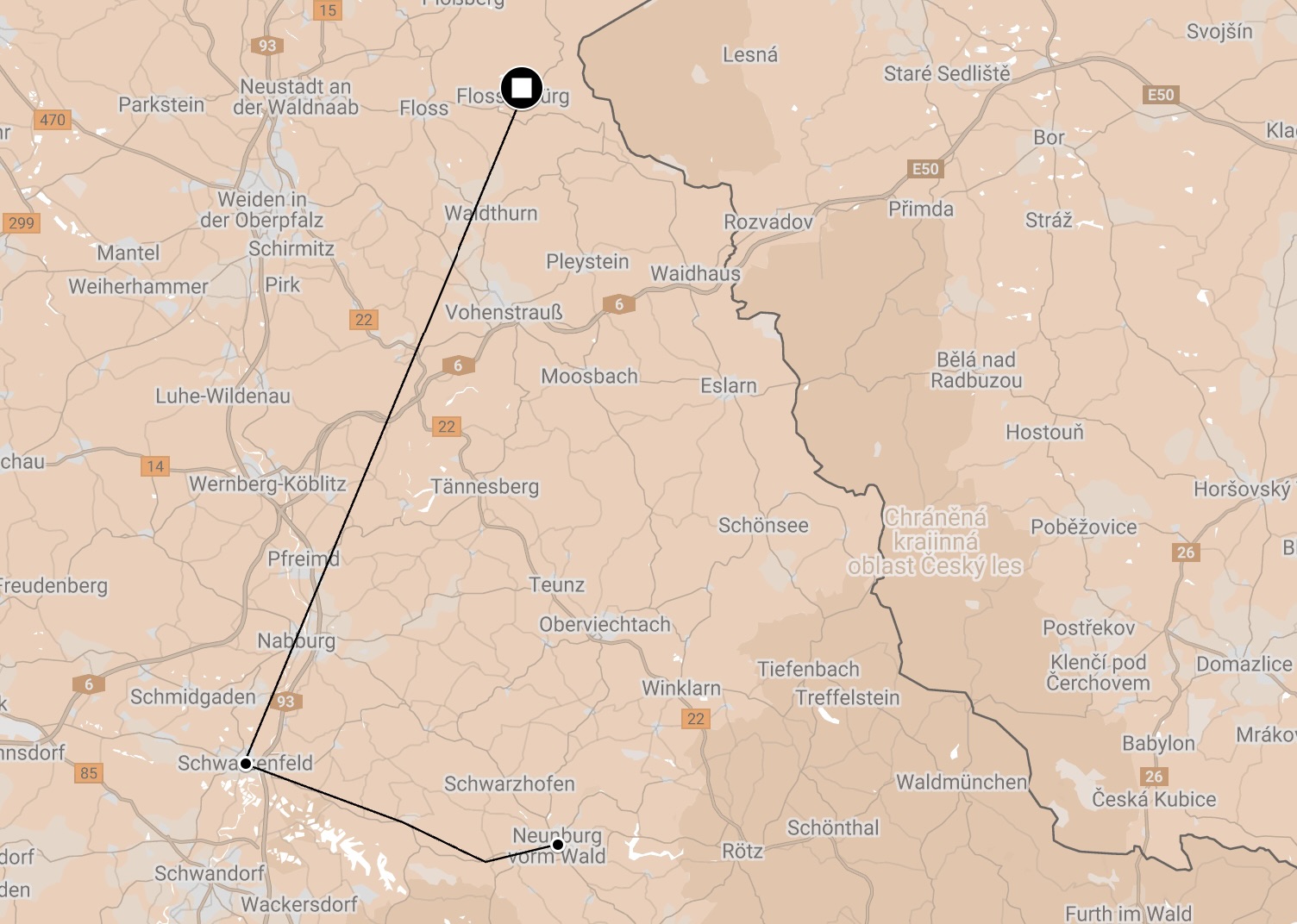
But on 16 April 1945, the SS loaded many of the priosners onto a train, intending to take them to Dachau concentration camp. The train came under fire in Schwarzenfeld, where it had sat in the sidings for several days. The SS forced the prisoners to continue on foot to Neunburg vorm Wald.
Kleinman was part of the group that proceeded on foot. He had already experienced a death march from Auschwitz and a death train to Sachsenhausen-Oranienburg. While on the march to to Neunburg vorm Wald, the prisoners were liberated by the American army. Kleinman was found hiding in a ditch by an American Jewish soldier from New York who took him to the field hospital. The other members of the Boys were also liberated here.
 About
About History
 Education
 Quilts
 FIlms
FIlms Photos
 News Media & Events
 Publications
 Donate