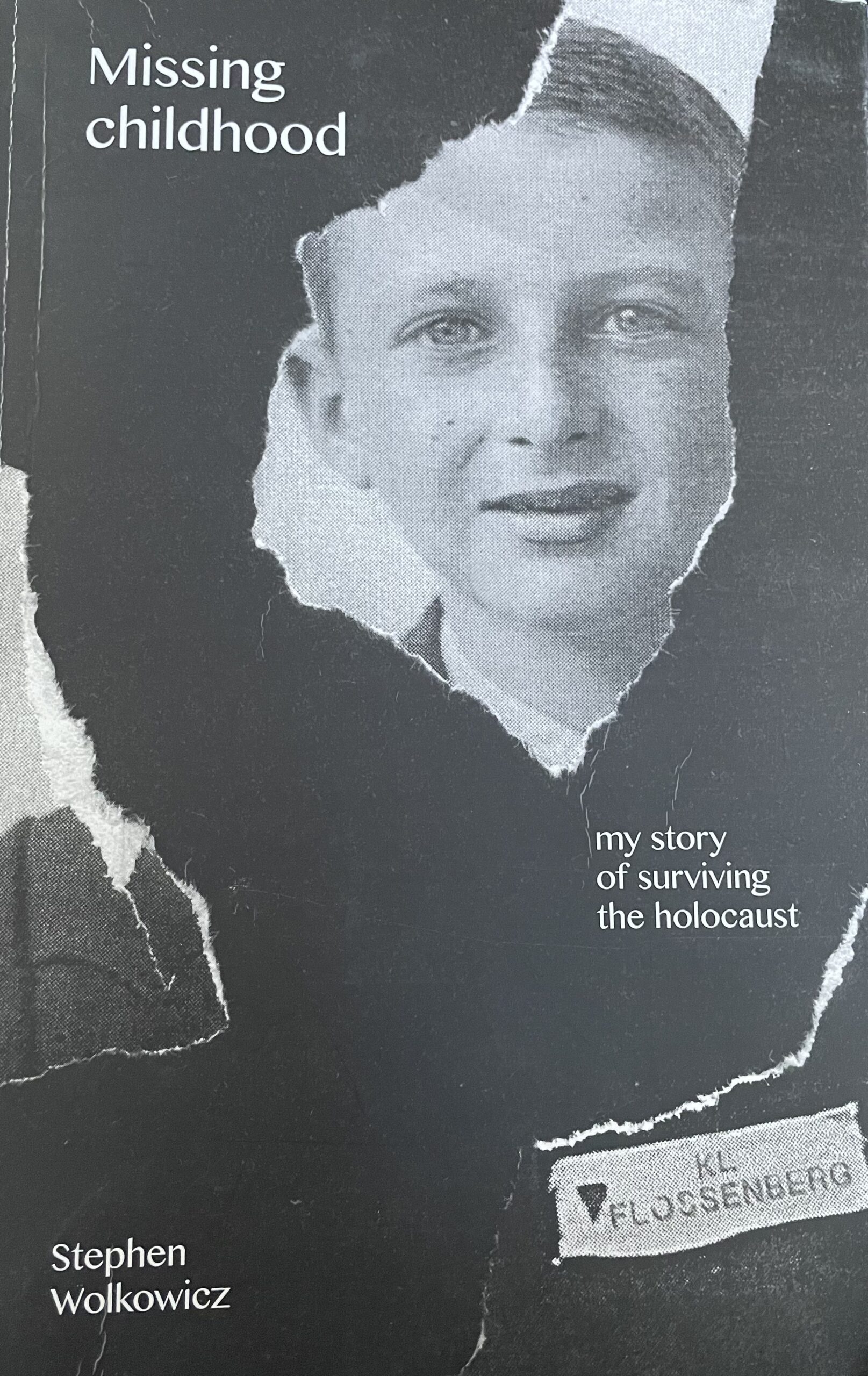
Missing Childhood is the short, 139-page memoir of Polish-born survivor Stephen Wolkowicz, who survived four years in the Lodz ghetto as a young child, only to endure the horrors of the concentration camps. After the war, he was one of 732 Jewish orphans flown to England by Jewish aid groups, collectively known as ‘The Boys’.
Pages 1-16 briefly describe the author’s pre-war childhood in Lodz and detail his family lineage, pages 17-41 discuss the German invasion of Poland and his confinement in the Lodz ghetto until August 1944. Pages 42-66 recount his deportation to Auschwitz-Birkenau and Stutthof concentration camp before being sent to Dresden and a death march to Theresienstadt, where he remained until liberation. Pages 67-92 detail the author’s life in post-war Prague and the UK, and emigration to Melbourne in 1948. Pages 93-122 describes the author’s life in Australia and New Zealand and his new family. Pages 129-139 presents final reflections, a bibliography of resources, a family tree and a timeline of events. Interspersed throughout the narrative are several scanned documents, maps and genealogical trees, as well as 16 pages of family photographs.
Stefan (Stephen) Wolkowicz was born 4 December 1933 in Lodz to secular Jewish parents Maryem (Maryla) and Pesjsach (Paul) Wolkowicz. The family was considered middle-class and spoke Polish. On 8 September 1939, German troops occupied Lodz and quickly introduced antisemitic laws. In December, the family was evicted from their home and moved to Bałuty, the slums of Lodz, which, in early February 1940, became a ghetto.
In the ghetto, the Wolkowicz family was crammed into an apartment with Stephen’s maternal grandparents and their son, his uncle Simon. The family was forced to work brutal hours, manufacturing supplies for the German army whilst enduring starvation and appalling sanitary conditions. In September 1941, Stephen’s grandmother died. A skilled mechanical engineer, Stephen’s uncle Simon was able to obtain an important position at a metal factory, which he used to secure life-saving work for his girlfriend, Molly, and his family – including the young Stephen. In September 1942, when Stephen was eight years old, an Aktion to deport the Lodz ghetto children to their deaths was launched, which Stephen narrowly survived by hiding in the apartment attic. Through Stephen’s connections, the Wolkowicz family was luckily placed on a list of 500 ‘experienced’ metal workers who escaped deportation to camps until August 1944 when the ghetto was liquidated and they were deported to Auschwitz.
After a few days, the Lodz prisoners were sent on a transport to Stutthof concentration camp. Whilst the men performed hard-labour, Stephen remained alone in the barracks. His grandfather Jakob could not endure the brutal conditions and died in October. The family remained in Stutthof until 24 November 1944 when they were transferred to a munitions factory in Dresden, a subcamp of Flossenbürg. On 13 February 1945, the city was firebombed by the allies whilst the prisoners hid in the cellar of the factory at the outskirts of the city. In mid-April, the prisoners were forced on a ten-day death march to Theresienstadt, during which both Stephen’s parents died. Stephen, Simon and Molly remained there until 8 May 1945 when Theresienstadt was liberated by the Russian Army.
After liberation, they left Theresienstadt for Prague, living off food provided by kind strangers and Russian soldiers. After two months, however, Simon and Molly arranged for Stephen to join a transport of Jewish orphans to England, organised and funded by the JOINT. On 14 August 1945, Stephen was flown to Northern England with 732 other children where he spent a few weeks in a dormitory bordering Lake Windermere, before he was sent to a boarding-house in Ascot. He lived there for a year with approximately 30 other boys.
Towards the end 1946, Stephen was moved to Glasgow, where at thirteen, he celebrated his Bar Mitzvah. He was enrolled in high school until 1948, when Simon and Molly obtained Australian landing permits from a surviving cousin. Stephen then travelled to Rome, living with Stephen and Molly for a few weeks in accommodation paid for by the JOINT, until transport was secured to Paris. There, they boarded a flight to Melbourne, arriving in September 1948. In Melbourne, Stephen finished school and studied engineering, graduating in 1955. In 1956 he became an Australian citizen and in January 1964, travelled to New Zealand where he met his wife, Sue. The couple married later that year, and Stephen moved to Wellington. In 1969, their only child Paul was born, and the family moved to Sydney in 1974. Sadly, Paul died in 1995 from a congenital health condition.
Missing Childhood provides a brief overview of the wartime experiences of a young boy and provides insight into child survivors and the post-war Jewish orphans known as ‘The Boys’. The memoir is not detailed and has not been professionally edited. The narrative is interspersed with sections devoted to Holocaust history and the experiences of the author’s extended family.
 About
About History
 Education
 Quilts
 FIlms
FIlms Photos
 News Media & Events
 Publications
 Donate