Members of the Boys were imprisoned in the Legionowo Ghetto.
The Legionowo Ghetto was one of a network of ghettos set up by Nazi Germany in which Jews were forced to live in occupied Poland. As with other ghettos in Czechoslovakia, Latvia, Lithuania and Poland, the Legionowo Ghetto was established to contain the region’s Jews and isolate them from the rest of the population until the Nazi leadership could decide on an answer to the so-called “Jewish Question.”
The Boys and their families were forced to move from their homes and were held in ghettos in Nazi controlled Czechoslovakia, Latvia, Lithuania and Poland, where they spent years living in dire conditions. The ghettos were not designed for the vast numbers of people forced to find space to live within them. As a result, multiple families shared cramped and insanitary accommodation.
The Boys were teenage and child-Holocaust survivors, who were brought to the UK after the war for rest and rehabilitation.
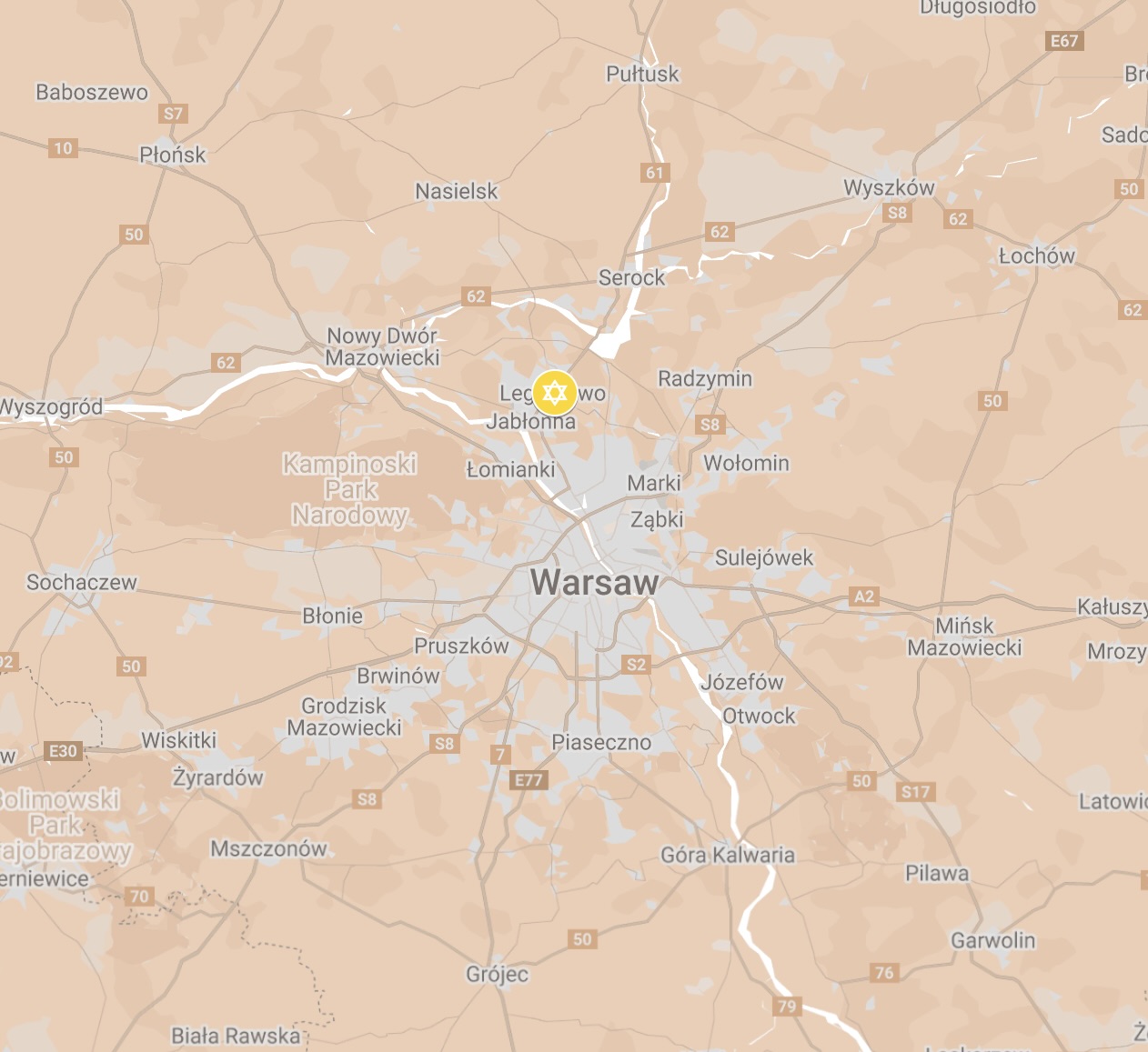
Legionowo is a city in Masovian Voivodeship in east-central Poland, approximately 23km north of Warsaw. To find out more about the Masovian Voivodeship and the Boys who grew up there click here.
Overview
The Legionowo Ghetto was established in early 1941. The ghetto held an estimated 3,600 Jews and was liquidated in October 1942, when its inhabitants were sent to the Warsaw Ghetto or deported directly to Treblinka extermination camp.
Layout
The ghetto was located in Ludiwisin, in the south western of Legionowo, encompassing several streets including Jagiellońska and Piłsudskiego.
Daily Life
Living conditions in the Legionowo Ghetto were extremely difficult. Families were confined in overcrowded buildings with minimal access to clean water and sanitation. Medical services were nearly non-existent, and outbreaks of disease were common. The Judenrat (Jewish council) attempted to provide aid but resources were severely lacking.
Deportations
The first deportations occurred in the summer of 1942, when several hundred Jewish families were sent to the Warsaw Ghetto.
Liquidation
Jews were rounded up in the early morning of 4 October 1942 and forced to assemble on Chrobry Street, outside the Judenrat building. 70 Jews were killed immediately, including the Judenrat Chairman Chil Rozenberg, and the Jewish Police chief Feldmann.
Those attempting to hide or flee were killed. Most, however, were later captured and killed by German forces or collaborators.
The community were then taken through the village of Struga to the station in Radzymin. From there, they were deported to the Treblinka extermination camp, along with others from Wołomin and Radzymin, where they were killed on arrival.
After the deportation, the ghetto area was looted and destroyed.
Jewish Resistance
There was no organised armed resistance in the Legionowo Ghetto. However, individual acts of defiance were recorded, including efforts to hide Jewish children with Polish families. A few Jews managed to escape and join resistance networks operating in the forests near Warsaw.
Memorialisation
Today, the history of the Legionowo Ghetto is commemorated by a plaque near the former ghetto area. A memorial also stands at the site of mass executions carried out during the liquidation. For information on visiting Masovian Voivodeship click here.
 About
About History
 Education
 Quilts
 FIlms
FIlms Photos
 News Media & Events
 Publications
 Donate